Most people search for an "Amazon seller success case study" hoping for a shortcut. A formula. Something they can copy on a Tuesday afternoon and start seeing sales by Friday. I'll be honest with you upfront — that's not how it works, and if this article told you otherwise, it would be lying to sell you something. What a good case study actually gives you is a way of thinking. A pattern you can recognise in your own business before it becomes an expensive mistake.
This article walks through a realistic, hypothetical Amazon seller journey — not a real client, not a verified statistic, just the kind of pattern that shows up again and again when someone starts selling on Amazon with more enthusiasm than strategy. If you're a student, a small business owner testing the waters, or a working professional thinking about a side income, this is written for you.
What Does "Amazon Seller Success" Actually Mean?
Ask ten people what success on Amazon looks like and you'll get ten different answers. One person means ₹50,000 a month in profit. Another means simply not losing money in the first six months. A third just wants to know their product works before quitting a job. None of these are wrong.
For the purpose of this article, success means something narrower and more useful: a seller who consistently makes informed decisions, tracks the right numbers, and grows without depending on luck. Sales spikes happen to lucky sellers too — the difference is whether the seller can explain why it happened and repeat it.
Amazon selling itself is fairly simple to describe. You list a product on Amazon's marketplace, Amazon (or you) handles storage and shipping depending on the fulfilment model you choose, and you compete for visibility against thousands of similar listings. Simple to describe. Not simple to do well.
Why This Topic Matters More Than It Looks Like It Does
Here's the thing most beginners miss — Amazon selling looks like an e-commerce skill, but it behaves more like a data and marketing skill with a warehouse attached. People join the platform thinking product sourcing is the hard part. It usually isn't. Sourcing a decent product is a weekend's work if you know where to look. Understanding why your competitor with a worse product outranks you? That takes months to genuinely understand.
Realistically, this matters because Amazon has become one of the largest entry points into digital entrepreneurship in India. Students use it to build early business experience. Working professionals use it to test ideas without quitting their jobs. Small business owners use it to reach customers their physical shop never could. The barrier to entry is low. The barrier to actually making money is not — and that gap is exactly where most people get stuck, confused about whether the problem is the product, the platform, or their own approach.
How Amazon Selling Actually Works, Step by Step
Before dissecting any case, it helps to understand the mechanics. Not the marketing version — the operational version.
- Account setup and category approval — some categories need Amazon's permission before you can even list a product.
- Product research and sourcing, where margins get decided before a single sale happens.
- Listing creation — title, bullet points, images, backend keywords — this is where most beginners quietly lose sales without realising it.
- Choosing a fulfilment model. FBA (Fulfilled by Amazon) means Amazon stores and ships for you. FBM (Fulfilled by Merchant) means you handle it yourself.
- Launch and initial reviews, which is genuinely the fragile part of the whole process.
- Advertising through Amazon PPC to get visibility while organic ranking is still weak.
- Ongoing optimisation — pricing, inventory, keyword tweaks, review management, and repeat, indefinitely.
Each of these steps can be done adequately by a beginner following a checklist. But they interact with each other in ways a checklist doesn't show. A great listing with poor inventory planning still fails. A well-priced product with weak images still gets ignored. That interaction is where structured learning — through a course, mentorship, or simply enough failed attempts — starts to matter more than raw effort.
A Realistic Example (Hypothetical, Not a Verified Case)
To be transparent: this is not a real client of mine, nor a documented case from any public source. It's a composite of the kind of journey that plays out constantly among new sellers, built to illustrate the decision points, not to claim specific results.
Imagine a small business owner in a Tier-2 city who manufactures home décor items — say, decorative wall clocks. He lists three products on Amazon with reasonably good photos and a competitive price. Nothing happens for the first three weeks. Not because the product is bad. Because Amazon's algorithm has no sales history to trust yet, and organic ranking without reviews or velocity is close to invisible.
He then runs a modest PPC campaign — not a huge budget, just enough to get a trickle of paid visibility. A few sales come in. A few reviews follow. Somewhere around week six or seven, something shifts: the listing starts appearing higher for a few long-tail keywords, and organic sales begin trickling in alongside the paid ones. This is the point where a lot of beginners either lean in and optimise further, or get impatient and switch products entirely, assuming the first one "didn't work." It depends on the numbers, honestly — sometimes switching is the right call, sometimes it's just quitting one week before momentum.
The pattern worth noticing isn't the timeline. It's that early sales rarely come from the algorithm liking you — they come from a nudge, usually paid, that gives the algorithm data to work with.
Benefits of Learning From Structured Case Analysis
Reading or building case studies — even hypothetical ones — trains a specific skill: pattern recognition under uncertainty. A few concrete benefits worth mentioning:
- It builds intuition about timelines, so you don't panic during the normal slow weeks every new listing goes through.
- It exposes decision points — fulfilment choice, ad spend, pricing — before you have to make them with real money on the line.
- Over time, it makes you faster at diagnosing why a listing is underperforming, rather than guessing.
None of this replaces doing the work yourself. But it does shorten the painful trial-and-error phase considerably.
Challenges Beginners Consistently Face
The challenges aren't evenly distributed across sellers — some struggle with money, some with time, some with plain confusion. A few show up again and again:
Inventory and cash flow tend to trip up sellers first, especially with FBA, where money gets locked into stock sitting in Amazon's warehouses. Then there's the review problem — new listings need reviews to rank, but customers rarely leave reviews for products with no social proof yet. It's a genuine chicken-and-egg situation, and there isn't one clean way around it beyond patience and, where policy allows, requesting reviews properly.
Advertising costs eat into thin margins faster than most beginners expect. And category restrictions can stall a launch for weeks before a single product is even listed, which nobody warns you about until you hit it.
Common Mistakes Sellers Make (And Why They Keep Happening)
| Mistake | Why It Happens | Better Approach |
|---|---|---|
| Pricing purely to undercut competitors | Feels like the fastest way to win the buy box | Price against your actual margin after fees, not just against competitors |
| Ignoring backend search terms | Not visible in the listing, easy to forget | Treat backend keywords as seriously as the title |
| Stopping PPC too early | Ad spend feels like a loss before it becomes an investment | Give a campaign enough data (usually a few weeks) before judging it |
| Launching too many products at once | Enthusiasm and fear of picking wrong | Validate one product thoroughly before scaling the catalogue |
The undercutting mistake deserves a second look because it's genuinely the most common one. Sellers see a competitor's price and drop below it, without checking what that competitor's actual cost structure looks like. They might be losing money too. You just can't see that from outside.
Best Practices That Actually Hold Up Over Time
Some of these will sound obvious written down. They're still ignored constantly in practice, which is the whole point of listing them.
- Treat your listing as a sales page, not a product description — images and bullet points do the selling, not just the informing.
- Track your break-even ACoS (advertising cost of sale) before running any campaign, so you know when an ad is actually profitable versus just generating vanity sales.
- Build a review-request habit within Amazon's allowed methods, right from the first order.
- Reassess pricing monthly, not reactively every time a competitor moves.
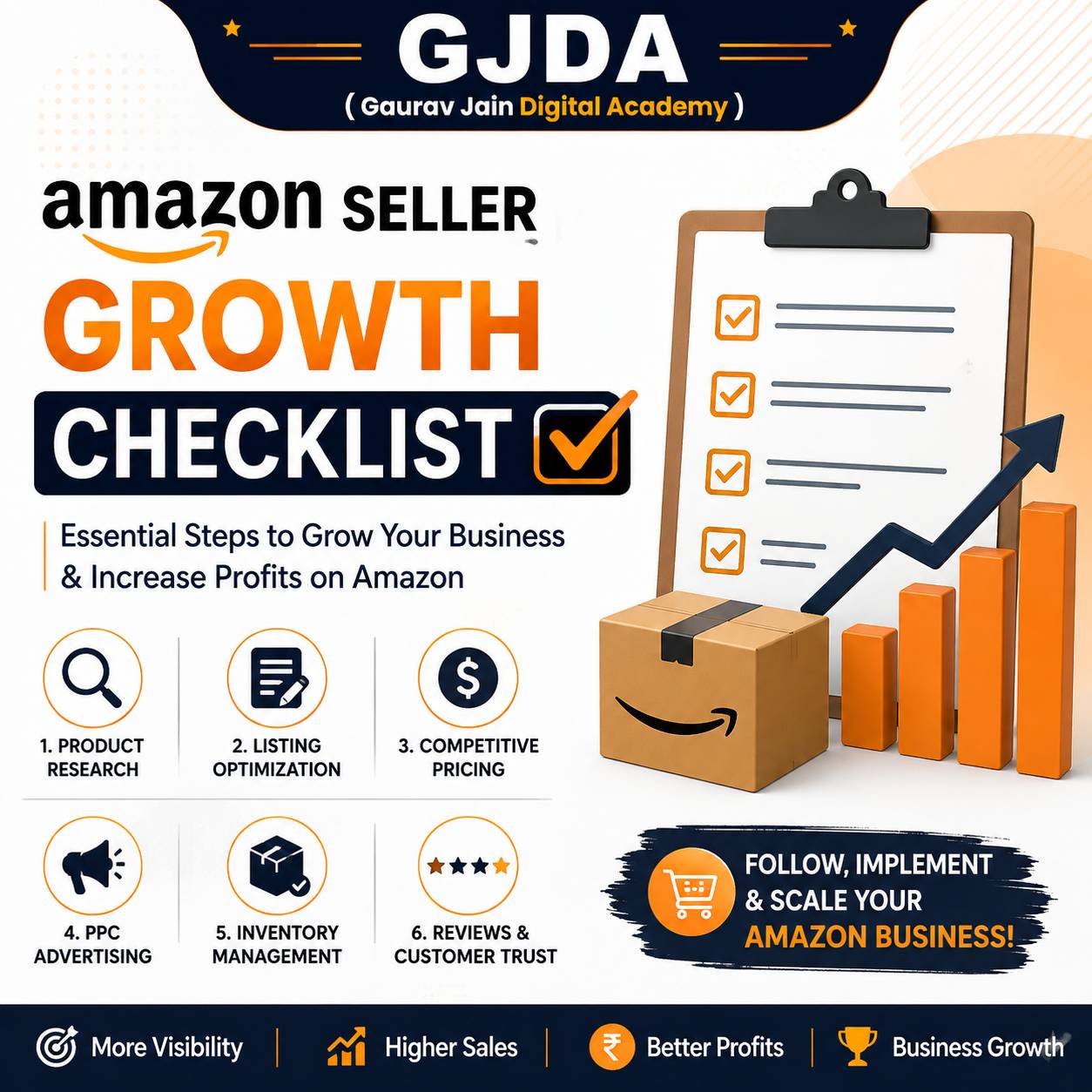
If you want a more complete framework for scaling past this early stage, the Amazon seller growth checklist walks through the exact stage-by-stage priorities once your first product starts moving.
Useful Tools for Amazon Sellers
Tools don't replace strategy, but the right ones save hours every week. Seller Central's own reports (Business Reports, Advertising Reports) are the first place to look — free, and most beginners never open them properly. Beyond that, keyword research tools help with listing optimisation, and basic spreadsheet tracking for margins and ad spend is, honestly, more valuable than most paid software in the early months. Fancy dashboards mean nothing if you don't already understand what number you're trying to move.
Career and Business Opportunities Around Amazon Selling
This space has grown into more than just "selling products." There are genuine career paths inside it now — Amazon account management for other brands, PPC specialists who run ad campaigns for multiple sellers, listing optimisation consultants, and virtual assistants who handle day-to-day seller operations. Professionals sometimes ask about interview expectations for these roles before applying, and the Amazon seller interview guide covers the kind of questions employers actually ask in these positions.
For those in Meerut and nearby regions specifically exploring this as a serious skill to build, structured Amazon Seller Training in Meerut can compress months of trial-and-error into a guided learning path — though plenty of sellers also learn by simply doing, slower, with more mistakes along the way. Both routes work. One is just faster.
Practical Assignment
Pick any three Amazon listings in a product category you're personally interested in — doesn't have to be your own product yet. For each listing, write down: the number of reviews, the approximate price, and one thing you'd immediately change about the images or title if it were yours. Then ask yourself why that listing might be ranking where it is despite its flaws. This exercise takes under an hour and teaches more than reading ten articles on listing optimisation.
Frequently Asked Questions
1. How much money do I need to start selling on Amazon?
It depends heavily on the category and product cost. Realistically, budget for product cost, GST registration, packaging, and at least a small advertising budget — many beginners underestimate the ad spend needed in the first two to three months.
2. Is FBA better than FBM for beginners?
Not universally. FBA reduces logistics headaches but ties up capital in inventory and adds storage fees. FBM gives more control but demands more of your time. Product size, margins, and how hands-on you want to be all decide this.
3. How long does it take to see profit on Amazon?
There's no fixed number here. Some listings show early traction within a month; others take three to six months to find their footing, especially in competitive categories. Anyone promising a guaranteed timeline is oversimplifying.
4. Do I need a company to sell on Amazon?
GST registration is required for most product categories in India, and that typically means at least a basic business registration. A few exempted categories exist, but they're limited.
5. Can I sell on Amazon without inventory?
Yes, through models like dropshipping, though Amazon has specific policies around this that differ from platforms like Shopify. It's worth understanding these limits properly before assuming it works the same way everywhere — the dropshipping success case study covers a comparable low-inventory model and its trade-offs.
6. Why is my product not showing up in search results?
Usually a mix of weak keyword usage, low sales velocity, or insufficient reviews. Occasionally it's a suppressed listing due to a policy issue, which is easy to miss if you're not checking account health regularly.
7. Is Amazon PPC mandatory to succeed?
Not strictly mandatory, but close to it for new listings. Organic ranking without any paid push is possible in low-competition niches, but rare in most categories now.
8. What's the biggest difference between Amazon selling and running a physical shop?
Visibility is algorithmic, not locational. A shop's success depends partly on footfall and location; an Amazon listing's success depends on data signals — reviews, conversion rate, keyword relevance — that most first-time sellers have never had to think about before.
9. Do I need a course to learn Amazon selling, or can I self-learn?
Self-learning is genuinely possible — plenty of successful sellers did exactly that. A structured training program mainly saves time by front-loading the mistakes others already made, rather than teaching something unreachable on your own.
10. How is an Amazon case study different from a general marketing case study?
The core decision-making logic overlaps quite a bit, actually. If you're curious how similar strategic thinking plays out outside Amazon, it's worth seeing why two similar businesses ended up with very different marketing outcomes despite nearly identical starting points — the same pattern shows up on Amazon between two sellers with near-identical products.
11. Does social media help Amazon sales?
Indirectly, yes — driving external traffic to a listing can improve Amazon's own ranking signals over time. The social media marketing case study is a useful reference for understanding how external campaigns are structured, even outside the Amazon context.
12. What's a realistic first goal for a new Amazon seller?
Not profit, honestly — that comes later. A realistic first goal is simply getting to ten to fifteen genuine reviews with a stable listing, because everything else compounds from that base.
Conclusion
Case studies, real or hypothetical, aren't useful because of the specific numbers involved — those numbers change with every product, category, and season anyway. They're useful because they show the order in which problems appear, and which ones deserve your attention first. A beginner who understands why sales are slow in week two behaves very differently from one who panics and slashes prices out of fear. That difference in thinking, more than any tool or trick, is usually what separates sellers who quietly figure it out from the ones who give up right before it clicks.
If you're building this skill in Meerut or nearby and want it structured rather than pieced together from scattered videos, GJDA's programs are built around exactly this kind of practical, step-by-step decision-making — but even without that, the thinking process itself is what to carry forward from here