Complete AI Marketing Guide to Learn AI Tools, Automation, and Modern Digital Marketing
9 Articles
 Sep 08, 2026
AI-Powered Competitor Research for Smarter Marketing
Learn how AI for competitor research helps analyze rivals, uncover market trends, track strategies, identify gaps, and build smarter marketing decisions.
 Aug 17, 2026
How AI for Marketing Analytics Improves Marketing Decisions
Learn how AI for marketing analytics transforms customer data into actionable insights, improves campaign performance, predicts trends, and drives growth.
 Aug 16, 2026
How AI Improves Email Marketing Strategy and Campaigns
Learn how to use AI for email marketing to create better campaigns, personalize content, automate workflows, improve engagement, and increase conversions.
 Aug 11, 2026
Top AI Certifications to Advance Your Digital Marketing Career
Compare the best AI certifications for digital marketers. Learn which programs build practical AI, automation, analytics, and marketing skills for career growth.
 Aug 04, 2026
How the Future of AI Marketing Careers Is Creating High-Demand Skills and New Job Opportunities Worldwide
Explore the future of AI marketing careers, emerging job roles, essential skills, salary trends, and how AI is transforming digital marketing opportunities worldwide.
 Aug 03, 2026
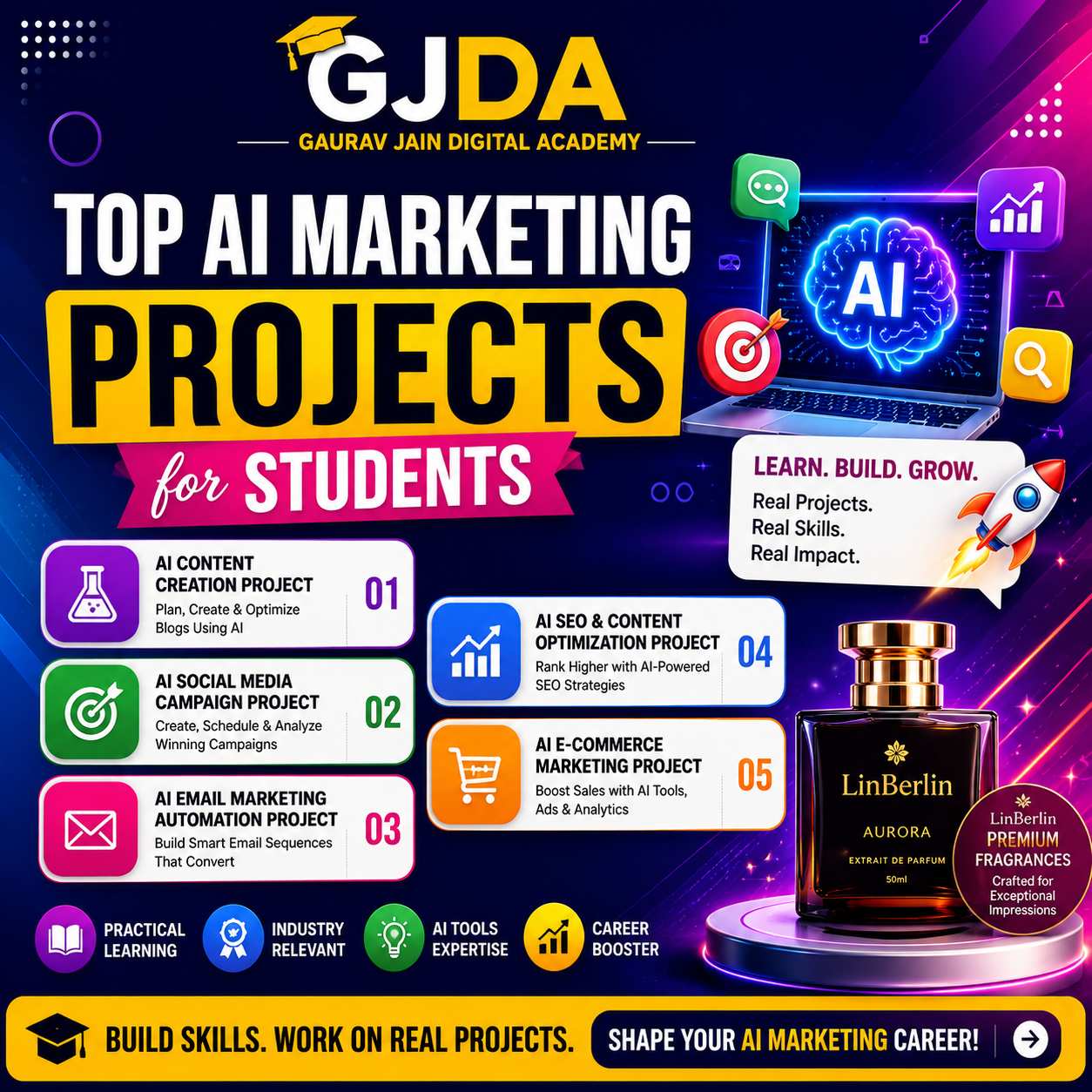
Top AI Marketing Projects for Students to Build Practical Skills and Career Experience
Discover the best AI marketing projects for students with practical ideas, ChatGPT use cases, real-world experience, portfolio tips, and career-ready skills.
 Aug 03, 2026
AI Marketing Case Study Using ChatGPT: Real Strategies, Practical Prompts and Proven Results
Learn how ChatGPT transforms AI marketing through a real case study with practical strategies, prompt examples, campaign planning, and measurable results.
 Aug 03, 2026
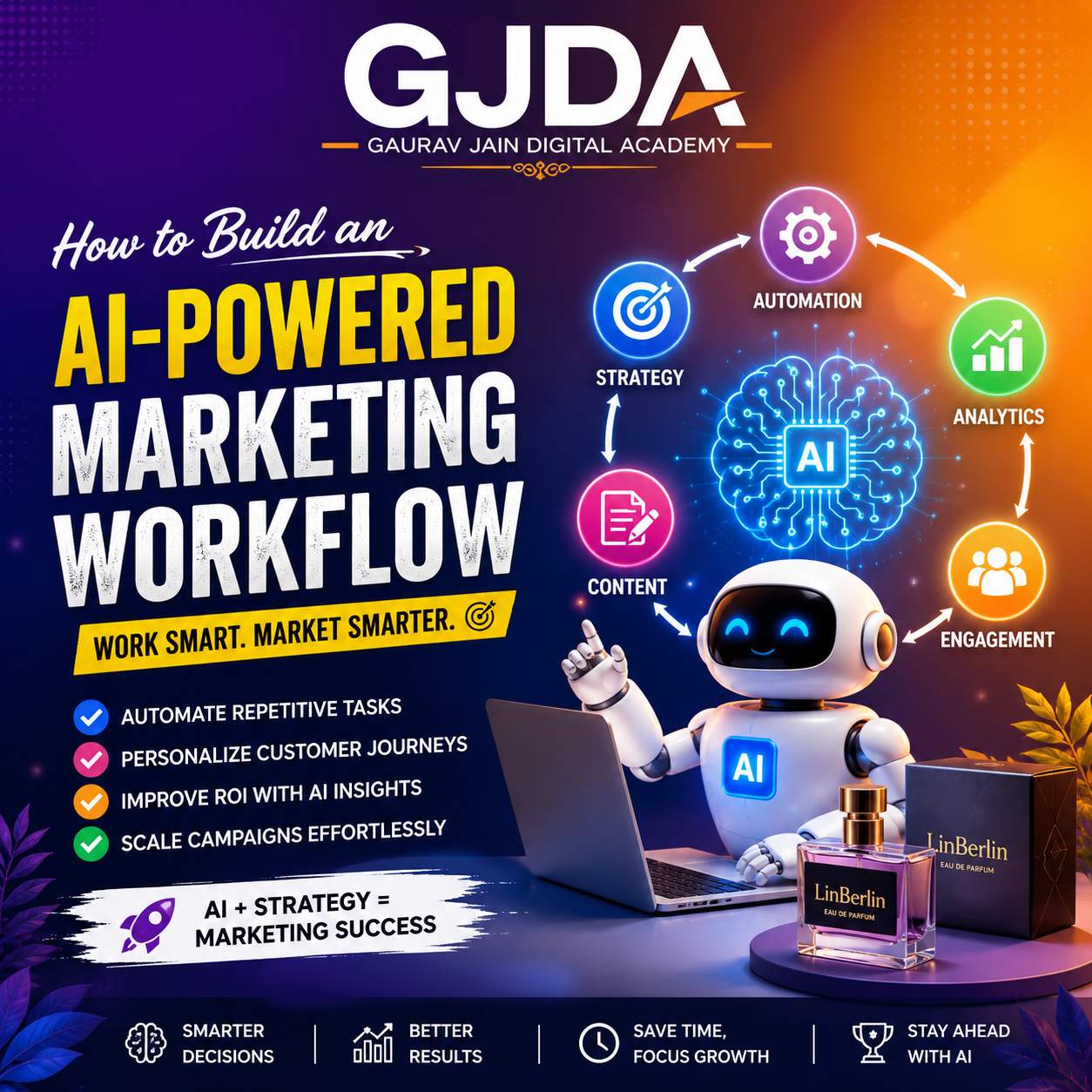
Build an AI-Powered Marketing Workflow to Automate Campaigns and Improve Marketing Results
Learn how to build an AI-powered marketing workflow that automates tasks, improves personalization, boosts ROI, and scales campaigns with proven strategies.
 Jul 31, 2026
How Artificial Intelligence Is Transforming Modern SEO Strategies for Better Search Rankings
Discover how AI is transforming SEO with smarter search, content optimization, automation, and ranking strategies to improve visibility and organic traffic.
Type "AI marketing" into Google and you'll get eleven million results, most of them recycling the same five sentences about ChatGPT and personalization. That's not what this page is. This is the page we wish existed when we started testing AI tools inside real marketing campaigns three years ago — the mistakes, the actual time saved, the tools that quietly stopped working after an update, and the ones that are still worth your money.
If you're a beginner trying to understand what AI marketing even means, stay. If you're a working marketer trying to figure out where AI actually moves the needle versus where it's just noise, also stay. We've split this so both of you get something out of it.
What Is AI Marketing?
AI marketing is the use of machine learning, natural language processing, and predictive algorithms to do the parts of marketing that used to require a human sitting at a desk for hours — writing ad copy variations, segmenting an email list, guessing which customers are about to churn, adjusting a PPC bid at 2am because a competitor dropped their price.
It's not one tool. It's not one skill. It's a layer that sits underneath research, content, ads, email, SEO, and customer service, quietly doing pattern-recognition work at a scale no team could do manually. A junior marketer running Facebook ads in 2019 might test 3 headline variations a week. An AI-assisted campaign today can test 30 in a day and kill the losers before they burn budget.
That said — and this matters — AI marketing doesn't replace marketing strategy. It replaces the grunt work around strategy. The tool doesn't know your brand voice, your customer's actual pain point, or why last quarter's campaign flopped even though the metrics looked fine. You still have to know that.
Why It Matters (More Than the Hype Suggests)
Here's the thing — most "AI is changing marketing" content is written by people who haven't run a campaign with these tools. The real reason it matters isn't that AI is smart. It's that AI is fast and tireless in a way humans aren't, and marketing has always been a game of iteration speed.
A brand that can test, learn, and adjust 10 times faster than its competitor wins the channel, eventually. Not always immediately. Sometimes the human-made ad still outperforms the AI-optimized one for weeks before the algorithm catches up. But over a quarter, over a year, the compounding advantage is real.
There's also a cost angle nobody likes to say out loud in polished content: AI is replacing entry-level marketing tasks. Copywriting interns, basic keyword research, first-draft social captions — a lot of that work has shrunk or disappeared at agencies. It's not all upside. We'll come back to this in the career section.
How AI Marketing Actually Works
Most AI marketing tools run on one of three underlying mechanisms, and knowing which one you're dealing with tells you what to expect from it.
- Machine learning models trained on historical performance data — used for predictive analytics, lead scoring, and ad bid optimization. These get better the more data you feed them, which means they're often mediocre in month one and genuinely useful by month three.
- Large language models (like the ones behind ChatGPT, Claude, and Jasper) — used for content generation, email copy, chatbot conversations, and prompt-driven creative work. These are good immediately but need heavy human editing to sound like your brand and not like every other LLM-written page.
- Rule-based automation with AI decision layers — used in email marketing platforms and ad platforms, where the "if this, then that" logic is augmented by a model deciding the "this" and "that" dynamically instead of a human hardcoding it.
Google Ads' Performance Max campaigns are a good example of the second and third types working together. You feed it assets — headlines, images, a bit of copy — and its models decide which combinations to show to which audience segments, adjusting in near real-time based on conversion signals. You don't see the decision-making. You just see the results, which is exactly why so many advertisers distrust it. Fair criticism, honestly. Black-box optimization means you lose granular control, and for some campaigns that trade-off isn't worth it.
A Real-World Example
An online skincare brand running Meta ads was manually writing and testing ad copy — maybe 4 to 6 variations a week, results reviewed every Friday. They switched to an AI copy tool feeding variations directly into Meta's Advantage+ campaign structure, running 40+ headline and copy combinations simultaneously. Cost per acquisition dropped from roughly $34 to $21 over six weeks. Not because the AI copy was "better writing" — honestly, some of it was worse, a little generic — but because the sheer volume of variations found winning combinations faster than a human testing cycle ever could.
The catch: engagement on organic social, where the brand's actual voice mattered more, didn't improve with AI-written captions. They eventually kept AI for paid ad iteration and reverted to human writers for organic content. It's not an either/or answer. It's a "use the right tool for the right job" answer, which is less satisfying but true.
Benefits of AI in Digital Marketing
| Area | What Changes |
|---|---|
| Speed | Campaign testing cycles shrink from weeks to days, sometimes hours |
| Personalization | Product recommendations and email content adapt per user, not per segment |
| Cost efficiency | Ad spend gets reallocated toward winning creative automatically, reducing wasted budget |
| Predictive insight | Churn risk, purchase likelihood, and lifetime value get flagged before a human would notice the pattern |
| Content volume | First drafts, meta descriptions, and social variations get produced faster, freeing humans for strategy and editing |
None of these are theoretical. All five show up in tool dashboards you can check yourself within a month of implementation.
The Challenges Nobody Puts on the Landing Page
AI-generated content, unedited, sounds like AI-generated content. Google has gotten noticeably better at recognizing thin, mass-produced AI content since its 2024 and 2025 helpful content updates, and sites that published hundreds of unedited AI articles saw real traffic drops. This isn't a rumor — it's documented in multiple site-wide deindexing cases discussed across SEO forums throughout 2025.
There's also a data quality problem. Predictive models are only as good as the data you feed them, and most small-to-mid businesses don't have clean enough historical data for the model to predict much of anything useful in the first few months. If your CRM has duplicate contacts and half your conversion tracking is broken, no AI tool fixes that. It just optimizes toward bad numbers faster.
And then there's the trust question — customers are increasingly wary of AI chatbots and AI-written emails that pretend to be personal. A 2024 Salesforce survey found a majority of consumers are uncomfortable with AI handling personal data for marketing purposes without clear disclosure. Ignore that at your own risk.
Common Mistakes Marketers Make With AI
- Publishing AI-generated blog content without fact-checking or editing for voice — this is the single biggest cause of ranking drops we've seen in client audits.
- Feeding an AI tool bad or incomplete data and trusting the output anyway.
- Using generic prompts ("write a marketing email about our sale") instead of detailed ones with audience, tone, and goal specified — the output quality difference is enormous.
- Automating customer-facing communication (chatbots, review responses) without a clear human escalation path.
- Assuming AI personalization means "insert first name" — that's 2015-era personalization wearing an AI label.
Best Practices That Actually Hold Up
Treat AI output as a first draft, always. Every single time. Even when it's good — especially when it's good, because that's when it's easiest to skip the edit and publish something that technically works but doesn't sound like anyone.
Layer prompt engineering into your workflow deliberately. A prompt that specifies audience, tone, format, length, and a real example of your brand voice will outperform a lazy prompt by a wide margin. This is a skill worth practicing on its own, not something you pick up by accident.
Keep a human in the loop for anything customer-facing, anything involving pricing or promises, and anything published under your brand name publicly. Automate the drafting, not the accountability.
Audit your data before you lean on predictive tools. It's boring work. It's also the difference between a model that actually helps and one that confidently tells you the wrong thing.
Useful AI Marketing Tools by Category
| Category | Tools Worth Testing |
|---|---|
| Content generation | Claude, ChatGPT, Jasper |
| SEO & keyword research | Surfer SEO, Clearscope, SEMrush's AI features |
| Ad optimization | Google Performance Max, Meta Advantage+ |
| Email marketing | Klaviyo's AI segmentation, Mailchimp's predictive send-time |
| Chatbots & customer service | Intercom Fin, Drift |
| Analytics & prediction | HubSpot's predictive lead scoring, Google Analytics 4 anomaly detection |
Start with one tool in one category. Learn it properly before adding a second. We've seen too many marketers bolt on five AI tools at once and end up unable to tell which one actually contributed to a result.
Career Opportunities in AI Marketing
This is a genuinely growing field, and it's not just "prompt engineer" job titles inflating the numbers. Roles like AI marketing strategist, marketing automation specialist, and conversion optimization analyst with AI tooling experience are showing up in job postings at a pace that's outstripping candidates who actually know how to use these tools beyond the surface level.
Salary ranges vary a lot by region and company size — entry-level digital marketers with demonstrated AI tool proficiency are commanding noticeably higher offers than those without it, and mid-level marketing managers who can show measurable AI-driven campaign results are increasingly the ones getting promoted into strategy roles. It depends heavily on your market, your portfolio, and honestly, how well you can explain the results in an interview rather than just listing the tools you've used.
If you want to build toward this seriously, our AI Digital Marketing Training Course walks through prompt engineering, AI SEO workflows, predictive analytics basics, and hands-on campaign work with the tools listed above — built specifically around this pillar page's structure so you're not learning theory disconnected from what you'd actually do on the job.
Practical Assignment
Pick one live campaign you're currently running — email, PPC, or a blog content calendar. Use an AI tool to generate five variations of one asset (subject lines, ad headlines, or article outlines). Don't publish any of them as-is. Edit each one for voice and specificity, then run the edited version against your usual output for two weeks. Track the difference. This single exercise teaches you more about where AI genuinely helps your specific brand than any amount of reading.
Frequently Asked Questions
Is AI marketing only for large companies with big budgets?
No. Most of the tools listed above have free tiers or start under $50 a month. The barrier isn't budget, it's usually knowing how to prompt and integrate them properly.
Will AI replace marketing jobs entirely?
Some tasks, yes — especially entry-level content drafting and basic ad testing. Strategy, brand judgment, and customer empathy are much harder to automate, and demand for people who can direct AI tools well is rising even as demand for pure execution roles shrinks.
What's the difference between AI marketing and marketing automation?
Marketing automation follows pre-set rules (if a user clicks this, send that email). AI marketing adds a decision-making layer that adjusts those rules based on patterns in the data, often without a human setting the exact trigger.
Do I need to know how to code to use AI marketing tools?
No. Most tools are built with no-code interfaces specifically for marketers. Prompt writing is more valuable than coding here.
Is AI-generated content bad for SEO?
Unedited, generic AI content can hurt rankings. Well-edited AI-assisted content that adds genuine expertise and original insight performs the same as human-written content in Google's current guidelines — Google has said repeatedly it doesn't penalize AI use itself, only low-quality output regardless of how it was produced.
What is prompt engineering and do marketers actually need it?
It's the practice of writing detailed, structured instructions to get consistent, high-quality output from AI tools. Yes, marketers need at least a working level of it — the gap between a lazy prompt and a well-built one shows up directly in output quality.
How do I start learning AI marketing as a complete beginner?
Pick one tool, one use case (say, email subject lines), and practice for two weeks before adding anything else. Our Beginner's Guide to Digital Marketing is a good starting point if you're newer to marketing fundamentals generally.
Is it ethical to use AI chatbots without telling customers they're talking to a bot?
Increasingly, no — and in some regions it's becoming a legal requirement to disclose. Transparency tends to build more trust than it costs, even when marketers assume otherwise.
What data privacy rules apply to AI marketing?
Depends on your region — GDPR in Europe, CCPA in California, and similar frameworks elsewhere generally require clear consent for data used in AI-driven personalization. Compliance requirements are evolving fast, so this is worth checking with current legal guidance rather than relying on last year's rules.
Can small businesses compete with large brands using AI marketing?
In some areas, yes — AI tools lower the cost of testing and personalization that used to require large teams. Large brands still win on data volume, but the gap has narrowed more than most small business owners realize.
What AI marketing skill is most valuable to learn first?
Prompt engineering combined with basic data literacy — knowing what your metrics actually mean so you can judge whether the AI's output is genuinely working or just looks busy.
AI marketing isn't a shortcut and it isn't optional anymore, either — it's somewhere in between, a set of tools that reward people who learn them properly and mostly waste money for people who don't. If you want structured, hands-on practice instead of piecing this together from scattered blog posts, our AI Digital Marketing Training Course covers everything on this page with live tool practice, real campaigns, and feedback from working marketers — check the related reads below for deeper dives into AI SEO, AI email marketing, and prompt engineering specifically.