Most people who say "I'm learning SEO" are actually watching random videos. One day it's backlinks, the next day it's schema, then somebody mentions AI Overviews and everything feels out of date again. That isn't learning. It's collecting fragments.
SEO is learnable in a sensible order, and the order matters more than the resources. If you're still deciding whether search is even the right place to start, my beginner's route into digital marketing gives the wider picture. If you already know it is, read on.
The primary intent behind this topic is simple: "In what order should I learn SEO, and what do I actually do at each stage?" So every section below answers that, and I've kept the promotion out of it. Use what helps.
What an SEO roadmap actually is
Search engine optimization means making a website easier for search engines to understand and more useful for the people who land on it, so it appears when someone searches for what you offer. A roadmap is just the sequence in which you pick up the skills.
Why does sequence matter? Because SEO skills depend on each other. Keyword research is pointless if you can't judge search intent. Technical fixes are pointless if the content behind them is thin. Link building is close to pointless if the page you're promoting isn't worth linking to.
Think of it as five layers: how search works, content and keywords, on-page work, technical health, and authority (links and reputation). Measurement runs through all of them.
Why it's worth learning properly
Paid ads stop the moment you stop paying. Organic visibility, when you earn it, keeps working for months, sometimes years. That's the main appeal for small business owners, and it's a fair one.
But I'll be honest: SEO is slow, and sometimes it's the wrong tool. A new shop that needs sales this month may do better starting with paid campaigns. I wrote about the situations where Google Ads doesn't fit, and the reverse is equally true. Neither channel wins everywhere.
How the roadmap works: stage by stage
The timings below are rough. Someone studying an hour a day will move slower than someone doing three. And they'd be different for everyone, so treat them as a guide, not a promise.
| Stage | What you learn | Rough time | You're ready to move on when... |
|---|---|---|---|
| 1. Foundations | How crawling, indexing and ranking work; SERP features; what search intent means | 1–2 weeks | You can explain why two similar-looking searches deserve different pages |
| 2. Keyword research and content | Finding topics, judging intent, writing pages that answer a question fully | 3–4 weeks | You can build a small keyword map for a real site |
| 3. On-page SEO | Titles, headings, internal links, images, URLs | 2–3 weeks | You can audit one page and list specific fixes |
| 4. Technical SEO | Site speed, mobile usability, sitemaps, robots.txt, indexing problems | 3–4 weeks | You can read a Search Console coverage report without panic |
| 5. Off-page and authority | Links, mentions, local profiles, reputation | 3–4 weeks | You can tell a useful link opportunity from a pointless one |
| 6. Analytics and reporting | Search Console, GA4, tracking what matters | 2 weeks, then ongoing | You can connect a traffic change to a probable cause |
| 7. Specialisation | Local, e-commerce, international, or content-heavy SEO | Ongoing | There isn't a finish line. That's the honest answer. |
Stage 1: understand the machine. Search engines find pages by following links, store what they find, then rank stored pages when someone searches. Three steps: crawl, index, rank. A page can fail at any one of them, and beginners often blame ranking when the real problem is that the page was never indexed. Learn to check that first.
Also learn intent here. Someone typing "best running shoes" wants comparisons. Someone typing "buy running shoes size 9" wants a product page. Same topic, different page. Skip this and everything later gets shaky.
Stage 2: keywords and content. Keyword research is not about finding the biggest number. A term with modest search volume that matches what your business actually sells will usually beat a huge, vague term you can't satisfy. Start with the questions your customers ask, then check them in a keyword tool.
Then write. Not "SEO writing," just clear writing that answers the question early and covers the follow-up questions. Does a longer page rank better? Not automatically. A page ranks when it satisfies the search, and sometimes 400 words does that.
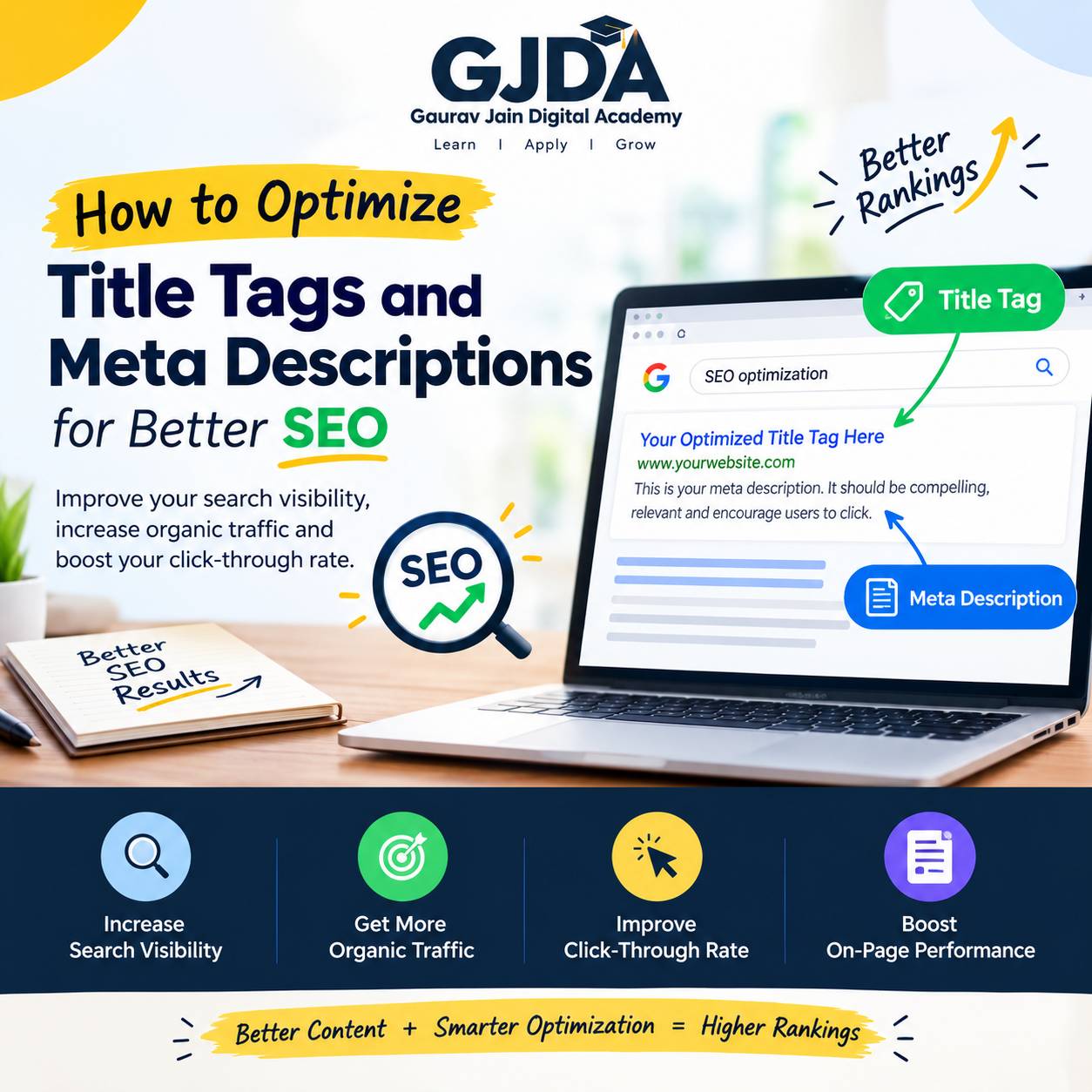
Stage 3: on-page. This is where most beginners can see results fastest, because it's fully in your control. Titles, meta descriptions, headings, image alt text, internal links. If you want to go deeper on the first two, there's a practical write-up on writing titles and meta descriptions that get clicked. One caution: Google sometimes rewrites your title or description anyway. Write them well regardless, but don't be shocked when it happens.
Stage 4: technical. You don't need to code. You do need to recognise problems: pages blocked by mistake, slow mobile loading, duplicate pages competing with each other, broken redirects. Learn what a sitemap does, what robots.txt can accidentally block, and how to test a page in Google's PageSpeed Insights.
A hypothetical example: a small clinic site launches with a "noindex" setting left on from development. Traffic is zero for weeks, and the owner assumes SEO "doesn't work." The fix takes two minutes. This kind of thing is common enough that I check for it first on any new site.
Stage 5: authority. Links from relevant, trustworthy sites act as a signal that others vouch for you. Local businesses also need consistent name, address and phone details across directories, and a well-kept Google Business Profile. Paid link schemes are the part to avoid, and I'd say avoid them firmly, because recovering from a penalty costs far more than the shortcut saves.
Stage 6: measurement. Google Search Console shows what people searched to find you, your impressions, clicks and indexing issues. GA4 shows what visitors did next. Learn both, but start with Search Console. It's free and closer to the source.
A worked example (hypothetical)
Say a small tailoring business in a mid-sized city wants more enquiries. It has a five-page website and no blog.
- Check that the site is indexed, and that Google Business Profile is claimed.
- List what customers actually ask: "blouse stitching cost," "alteration near me," "how long does a suit take."
- Give each service its own page with a clear title, and answer those questions on the page.
- Link related pages to each other, and make sure the phone number can be tapped on mobile.
- Track enquiries and search queries in Search Console for a couple of months before changing anything.
Nothing exotic there. Most small-business SEO looks like this, which is exactly why doing the basics properly beats hunting for tricks.
Benefits of learning it in this order
You stop guessing. When traffic drops, you know whether to check indexing, content, or links first. You can also talk to agencies and developers without being lost, which matters a lot if you run a business. And for job seekers, it gives you something to show: audits and small projects rather than certificates alone.
Challenges you should expect
Results take time, often months. That's uncomfortable, and I won't pretend otherwise. Search algorithms change, so some advice ages quickly. And there's rarely a single cause for a ranking change; several things move at once, so you'll often be working with a best guess instead of proof.
AI-generated answers in search results add another wrinkle. Nobody has a settled playbook yet. Clear, accurate, well-structured pages seem to remain the safest bet, but that's an observation, not a guarantee.
Common mistakes
- Starting with tools instead of concepts. A tool gives you numbers. It doesn't tell you what they mean.
- Chasing high-volume keywords your site has no chance of ranking for yet.
- Copying a competitor's pages almost word for word. It doesn't work, and it teaches you nothing.
- Stuffing the same phrase into every paragraph.
- Buying links because a seller promised "fast results."
- Changing ten things at once, then not knowing which one helped. Or hurt.
Best practices that hold up
Write for the person first and the search engine second. Give each page one clear purpose. Fix indexing before you polish content. Change one thing at a time when you can, and note the date. Keep a simple log; it will teach you more than any course, because it's your own data.
And revisit older pages. Content that was accurate two years ago may not be now.
Useful tools
| Tool | Use it for | Cost |
|---|---|---|
| Google Search Console | Queries, clicks, indexing problems | Free |
| Google Analytics (GA4) | Visitor behaviour, conversions | Free |
| Google Keyword Planner | Rough keyword ideas and volumes | Free with an Ads account |
| PageSpeed Insights | Speed and mobile performance checks | Free |
| Screaming Frog SEO Spider | Crawling a site for broken links, titles, duplicates | Free version has a URL limit; paid beyond that |
| Ahrefs, Semrush | Deeper keyword and backlink research | Paid |
You don't need the paid ones on day one. Really. Plenty of people use AI assistants for brainstorming topics and drafting outlines too, and there's a practical walkthrough of using ChatGPT in marketing work. Just verify anything factual it tells you before it goes on a page.
Career opportunities
Typical roles include SEO executive, content strategist, technical SEO specialist, local SEO specialist, and in-house marketer at a company. Freelancing is common too, though it depends heavily on your ability to show real work. If you're heading to interviews, the practical set in these SEO interview questions for freshers shows what employers tend to ask. Salary ranges vary widely by city and experience, so I won't quote figures here.
If you'd rather learn with a structured path and feedback, a classroom option like our institute is one choice. Self-study works as well, if you're disciplined and build real practice sites.
The order in this complete guide is close to how I'd sequence any syllabus. And if you're near Meerut and prefer learning in person, our training center runs sessions in that format. That's all I'll say about it; the roadmap works without us.
Practical assignment
Pick a real website: your own, a friend's, or a local business (with permission). Then do this over two weeks:
- Search for the site's name in Google using the site: operator and note how many pages are indexed.
- Pick five pages and write down each page's target search intent in one sentence.
- Rewrite the title and meta description for two of them.
- Run PageSpeed Insights on the homepage and list the three biggest issues in plain words.
- Find three questions customers ask that no page answers, and draft one page to answer them.
Keep the before-and-after notes. That document becomes your first portfolio piece.
Frequently asked questions
How long does it take to learn SEO?
Basics: roughly two to three months of steady study. Being genuinely good takes longer, and there isn't one correct answer because it depends on practice more than hours.
Can I learn SEO without coding?
Yes. Basic HTML awareness helps, since you'll read page source now and then, but you don't need to write code.
Is SEO still worth learning with AI search?
I think so. AI answers still draw on web content, so clear, trustworthy pages still matter. How much traffic that sends is still shifting, though.
How long before a website ranks?
Often several months for competitive terms, sometimes faster for very specific local searches. Anyone promising a fixed date is guessing.
What's the difference between on-page and off-page SEO?
On-page is what you control on your own site: content, titles, structure. Off-page is what others say or link about you.
Do I need to pay for SEO tools?
Not at the start. Search Console, GA4 and PageSpeed Insights cover a lot.
Is SEO better than Google Ads?
Neither, in general. Ads bring faster traffic for a cost; SEO builds slower but lasting visibility. Many businesses use both.
Can a small local business do SEO itself?
For the basics, yes: a Business Profile, clear service pages, reviews. Highly competitive markets are harder.
What should I learn first, keywords or technical SEO?
Foundations and intent first, then keywords. Technical comes after, unless your site isn't being indexed at all.
Do SEO certificates help in getting a job?
Somewhat. Employers usually care more about audits, projects and how you explain your reasoning.
Conclusion
Start with how search works, move to content and on-page work, then technical and authority, and measure throughout. Do the practical assignment on a real site, because reading alone only takes you so far. And expect to keep learning; I still do.