Every year I sit across from students who've spent weeks memorising definitions of Facebook Ads Manager and CPM, and then freeze the moment an interviewer asks something as simple as "how would you handle a client who wants viral content on a zero rupee budget?" That gap between knowing the terms and knowing how to think is exactly what this article is trying to close.
If you're preparing for a social media marketing interview — whether it's your first job, a freelance pitch, or a step up from executive to manager — this is written the way I'd actually prep a student in a real session, not the way a keyword list gets stitched together online.
What is Social Media Marketing (and why do interviewers test it differently)?
Social media marketing interviews rarely test whether you know what Instagram or LinkedIn is. Everyone knows that. What they're actually testing is whether you understand platform behaviour, audience psychology, and business outcomes well enough to make decisions under pressure — because that's the job, day to day.
At its core, social media marketing is the practice of using platforms like Facebook, Instagram, LinkedIn, YouTube, and X to build brand visibility, engage audiences, and drive measurable business results — leads, sales, community trust, or awareness, depending on the goal. Simple definition. But interviewers rarely stop there, and neither should your answer.
A beginner's answer says "it's promoting a brand on social platforms." A stronger answer adds context: which platform, which objective, which metric proves it worked. That distinction — knowing the "why" behind the "what" — is what separates a candidate who gets shortlisted from one who doesn't.
Why Social Media Marketing Knowledge Matters in Interviews
Because almost every business today, small or large, runs at least one active social channel, and most hiring managers have been burned by candidates who can talk about trends but can't execute a campaign brief. Realistically, interviewers aren't checking your vocabulary. They're checking whether you'd waste their ad budget in month one.
This matters more for small business owners attending interviews on behalf of their own brand — yes, that happens, especially when owners want to understand what they're paying an agency for — because the cost of not knowing this stuff isn't a rejected application. It's a poorly spent marketing budget.
How Social Media Marketing Interviews Actually Work
Most interviews follow a rough pattern, even if no two are identical. Understanding the pattern helps you prepare smarter instead of memorising 200 random questions off some list.
- Round one usually checks basics — platforms, terminology, tools you've used
- Round two tests applied thinking — "what would you do if engagement dropped 40% overnight"
- Round three (for senior roles) tests strategy and business alignment — budget allocation, KPI selection, stakeholder communication
Not every company runs three rounds. Small agencies sometimes compress everything into one 30-minute call. Bigger companies stretch it across weeks. There isn't one fixed format, and that's exactly why understanding the underlying skill matters more than rehearsing scripted answers.
Real-World Example: A Common Interview Scenario
Here's a hypothetical scenario I use in training sessions, not a real client case, but it mirrors what actually gets asked:
An interviewer says: "Our Instagram page has 10,000 followers but each post gets barely 50 likes. What's going wrong, and what would you check first?"
A weak answer jumps straight to "I'd run more ads." A stronger answer investigates first — is the follower base real or bought, is the posting time misaligned with the audience's active hours, has the content format shifted away from what originally attracted those followers, is the algorithm deprioritising the account for some reason. Diagnosis before prescription. That's the mindset interviewers are actually probing for.
Benefits of Preparing the Right Way
Good preparation does more than help you answer questions. It changes how you sound in the room.
| Preparation Approach | What It Signals to the Interviewer |
|---|---|
| Memorising definitions only | Surface-level knowledge, likely to struggle with real tasks |
| Understanding platform algorithms and metrics | Practical readiness, lower training cost for the employer |
| Knowing how to tie social activity to business goals | Strategic thinking, suitable for growth into management roles |
Small business owners specifically benefit from this kind of prep because it helps them evaluate vendors and freelancers correctly. If you can't tell whether your social media manager's answer to "why did reach drop" is competent or a cover-up, you're at a disadvantage in every future conversation with them.
Challenges Candidates Usually Face
Three come up again and again in my classroom, and they're not equally common — one of them causes far more damage than the other two combined.
The biggest one: candidates confuse activity with strategy. They'll describe posting five times a day, running boosted posts, replying to comments — all correct actions — but can't explain why those actions were chosen over alternatives. Interviewers notice this fast.
The second: outdated knowledge. Algorithms change often enough that something true eighteen months ago about, say, Instagram Reels reach, may no longer hold. It depends on the platform's current priorities, and honestly, nobody outside the platform's own team knows the algorithm with full certainty. Good candidates say "based on current trends" instead of stating things as permanent fact.
The third, smaller but real, is nervousness around numbers. Many creative-minded candidates avoid metrics conversations because they're not confident with data. This one is fixable with practice far more easily than the first two.
Common Mistakes in Social Media Marketing Interviews
- Giving textbook definitions without practical context — interviewers can tell within seconds
- Not knowing basic metrics like engagement rate, reach vs impressions, or CTR, which comes up in almost every interview regardless of seniority
- Overselling personal social media use ("I have 5000 followers on my own page") as professional experience — these are related but not the same skill
- Failing to ask clarifying questions before answering scenario-based problems, which actually signals overconfidence rather than competence
I'll be honest — that last one surprises students the most. In a real job, nobody hands you a perfectly clear brief. Asking "what's the current budget" or "what platform specifically" before answering a scenario question usually earns points, not penalties.
Best Practices Before Your Interview
Preparation doesn't need to be elaborate. It needs to be targeted.
- Study 2–3 real brand pages actively and note what's working and what isn't — this gives you material for scenario questions
- Practice explaining metrics out loud, not just reading definitions silently
- Prepare one example of a campaign idea, even hypothetical, with a clear objective and a way to measure success
- Know the difference between organic and paid social, because this question appears in some form almost every time
If you want a structured way to build this readiness rather than picking it up piecemeal, a proper Social Media Marketing Training program usually covers platform strategy, analytics, and live tool practice together, which is hard to replicate from scattered YouTube videos alone.
Useful Tools Worth Knowing Before an Interview
You don't need to be an expert in every tool listed below. But recognising names and roughly what each does avoids awkward blank stares.
| Tool | Primary Use |
|---|---|
| Meta Business Suite | Managing Facebook and Instagram content and ads |
| Canva | Quick design for social posts and creatives |
| Hootsuite / Buffer | Scheduling and multi-platform management |
| Google Analytics | Tracking traffic driven from social channels |
| Native platform insights (Instagram Insights, LinkedIn Analytics) | Understanding reach, engagement, and audience data directly |
Career Opportunities After Building This Skill
Roles in this space range wider than most people assume — social media executive, content strategist, community manager, paid social specialist, and eventually social media manager or head of digital. Salary and scope vary a lot by city, company size, and whether the role is agency-side or in-house, so I won't put a fixed number here since that changes too often to state reliably.
What I will say from years of watching students move through this field: candidates who understand both content and data — not just one — get promoted faster. Purely creative folks plateau at execution roles. Purely analytical folks sometimes struggle with brand voice work. The ones who blend both move up.
Interviewers in this space often ask overlapping questions from adjacent fields too — expect some crossover with general digital marketing interview questions, and occasionally with paid advertising concepts from Google Ads if the role includes budget handling.
Practical Assignment
Pick any one active Instagram or LinkedIn business page — not your own — and spend 20 minutes analysing it. Write down: what's their posting frequency, what content format gets the most engagement, and one specific change you'd suggest if you were hired to manage that page next month. Bring that analysis into your next interview as a talking point. It shows initiative, and it gives you something concrete to discuss instead of generic answers.
Frequently Asked Questions
1. What is the most commonly asked social media marketing interview question for freshers?
"What's the difference between organic and paid social media marketing?" comes up almost universally. Know it cold, with one example of each.
2. Do I need to know coding for a social media marketing job?
No. Basic comfort with tools and analytics dashboards is enough. Coding helps for advanced automation roles but isn't a baseline requirement.
3. How do I answer "how do you measure social media success" in an interview?
Tie it to the business goal first — awareness, leads, or sales — then name the specific metric that maps to it, like reach for awareness or conversion rate for sales. Avoid naming metrics without connecting them to a purpose.
4. Is a personal Instagram following enough experience for this job?
It helps show platform familiarity, but it's not the same as managing a brand account with business objectives. Be honest about this distinction in interviews rather than overstating it.
5. What's a good answer for "how would you handle negative comments on a brand's page"?
Explain a calm, brand-appropriate response process — acknowledge, address if genuine, escalate if it's abuse or a serious complaint, and never delete comments just because they're critical unless they violate policy.
6. Are certifications necessary for social media marketing interviews?
They're not mandatory everywhere, but they help, especially for freshers with no work samples yet. Practical portfolio work usually carries more weight than the certificate itself.
7. What should small business owners specifically prepare before hiring a social media manager?
Understand baseline metrics enough to evaluate reporting, and prepare a clear list of business goals — because "grow our social media" without a specific goal makes it hard to judge whether a hire is actually performing.
8. How is a social media marketing interview different from an SEO interview?
Social media interviews focus more on content, audience behaviour, and platform trends, while SEO-focused interviews lean more on technical and search-ranking factors. There's some overlap in analytics thinking, but the day-to-day skills differ quite a bit.
9. What if I don't have professional experience — can I still clear the interview?
Yes, particularly for entry-level roles. Bring self-initiated work — a mock campaign, an analysis of a real brand page, anything that shows applied thinking rather than just theory.
10. Do experienced professionals get asked different questions than freshers?
Yes — expect more strategy, budget allocation, and team management questions at senior levels, closer in style to what shows up in interview prep for experienced SEO or marketing professionals, just applied to the social media context instead.
11. What's a common misconception about social media marketing jobs?
That it's mostly about "being creative" or "posting nice pictures." In practice, a large part of the job is analysis, planning, and understanding why something performed the way it did — the creative piece is only one part of it.
Conclusion
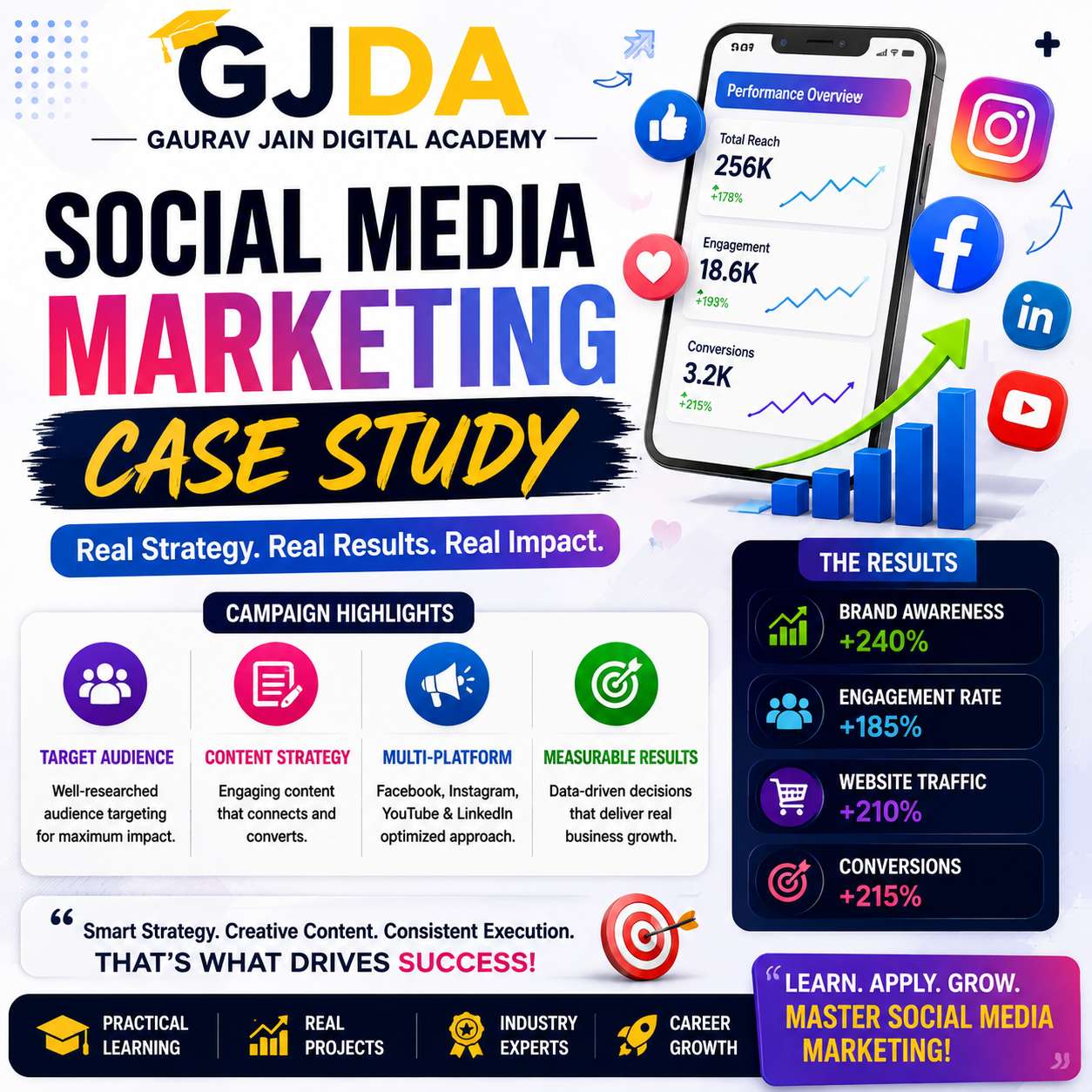
There's no shortcut that replaces actually understanding platforms, metrics, and audience behaviour — and honestly, that's a good thing, because it means preparation genuinely pays off rather than luck deciding the outcome. If you want to see how this thinking applies in a full campaign, worth reading through a real social media marketing case study before your next interview to connect theory with an actual example.
And if you're starting from scratch and want structured, hands-on guidance rather than piecing things together from scattered sources, you're welcome to explore the course we run at our academy — though honestly, whether you learn it there or elsewhere, the goal should be the same: understand the "why," not just the "what."