Advanced Flipkart Selling Strategies: What to Do After You Have Your First Orders
Most sellers hit a wall about two or three months in. The account is live, the catalogue is uploaded, a few orders trickle in every week, and then nothing much changes. Adding more products doesn't fix it. Dropping prices doesn't fix it either, or not for long.
That wall is what "advanced" selling on Flipkart is really about. It isn't secret tricks. It's understanding how the marketplace decides who gets shown, who gets trusted, and who keeps money after returns, ads, and commission. This article is written for people who already know how to create a listing and want to know what to do next.
One note before we start: Flipkart changes fees, programmes, and policies fairly often. Anything I describe about rules or charges should be checked against your own Seller Hub before you act on it.
What "advanced" Flipkart selling actually means
It means shifting from "getting products online" to "managing a small retail business inside someone else's platform". Basic selling is registration, GST details, catalogue upload, and shipping. Advanced selling is about four things working together: visibility (search and ads), conversion (listing quality and price), reliability (fulfilment, cancellations, returns), and profit (what is left after everything).
Beginners usually work on only the first. That's the misconception worth killing early: more visibility does not equal more profit. Sometimes it means more loss, faster.
Why it matters more than it used to
Marketplaces are crowded. In most categories, dozens of sellers offer near-identical products, so the platform has to pick whose listing appears first. It picks based on signals it can measure: how often people buy after clicking, how often orders are cancelled or returned, how quickly you dispatch, and what buyers say afterwards.
Which means two sellers with the same product and the same price can get very different results. The difference is rarely luck.
If you are still building your foundation, the guide on increasing sales on Flipkart covers the basics that everything below builds on.
How the strategy works: five levers you control
Think of your store as five levers. You won't pull all of them at once, and honestly you shouldn't.
- Listing quality. Title, images, specifications, and description. This is what turns a click into an order. Flipkart search works on keywords, so your title should carry the words buyers actually type, in a natural order. Use category-specific attributes fully. Half-filled specifications quietly hurt you.
- Pricing. Not the lowest price. The price that leaves you a margin and still looks fair next to competitors.
- Fulfilment and service level. Dispatch on time, pack properly, keep cancellations low. A slow or unreliable seller gets penalised in ways you don't always see directly.
- Advertising. Flipkart Ads (sponsored listings inside search and category pages) can buy visibility, but only pays off if the listing already converts.
- Returns and ratings. The lever most people ignore until it hurts.
The order matters. Fix listing quality before ads. Fix returns before scaling. Ads on a weak listing are just a way of paying to be ignored.
Real-world example (hypothetical)
Let me use an imaginary seller, so no one mistakes this for a real result. Suppose someone sells a stainless steel water bottle. Selling price is ₹499. Commission and fees together take ₹90, shipping takes ₹60, and the product costs ₹230 to source. That leaves about ₹119 per order before returns and ads.
Now add returns. If one order in ten comes back and the seller loses roughly ₹100 on each return (return shipping, damaged goods, repacking), that's about ₹10 gone per order on average. Then ads: if it costs ₹40 in ad spend to get each sale, the profit drops to roughly ₹69. Still positive. But if the return rate rises to one in five and ad cost per sale rises to ₹80, profit falls to about ₹19, and that's before any packaging or staff time.
Same product, same price, and margin has shrunk to almost nothing. Not because the seller did anything obviously wrong. This is why advanced sellers track profit per order, not orders per day.
Benefits of working on these levers
Better rankings come slowly, but they tend to stay. A listing that converts well and gets fewer returns is easier to keep visible, and you rely less on paid ads over time. You also get more predictable cash flow, which small businesses need far more than they admit.
And there's a quieter benefit. Once you know your numbers, you can say no to bad products and bad sale events. That's worth more than any hack.
Self-ship or Flipkart fulfilment: which is better?
It depends. There isn't one correct answer.
| Point | Self-ship | Fulfilled by Flipkart (Smart Fulfilment) |
|---|---|---|
| Control | You handle packing and dispatch, so you control quality and speed | Flipkart stores and ships, so you control less |
| Delivery speed and buyer trust | Depends on your courier and process | Often better, and eligible listings can show badges that buyers like |
| Cost | Shipping fees plus your own packing time | Storage and fulfilment charges, which vary by product size and weight |
| Good for | Custom, fragile, or low-volume products | Fast-moving, standard products with steady demand |
| Risk | Late dispatch, poor packing | Stock sitting unsold, storage fees adding up |
Realistically, a seller with slow-moving stock should be careful about fulfilment programmes, because storage charges keep running whether or not the product sells. Check the current fee card before sending inventory.
Common mistakes I see sellers make
Chasing sale events without doing the maths is the big one. Big sale periods bring volume, and volume feels like success. But discounts, higher return rates, and stock-outs can turn a busy week into a loss-making one. Not always. Sometimes the volume pays off handsomely. But you should know which before you commit stock.
Copying the lowest-priced competitor comes second. You don't know their cost structure. They might be clearing old stock or losing money deliberately.
Then there are listings with weak images and vague titles, running ads anyway. Ad money is spent on clicks, and clicks on a poor listing rarely become orders.
Ignoring return reasons is the one that hurts most quietly. Flipkart gives you return and cancellation data. Read it. "Wrong size", "not as described", and "damaged" each point to a different fix (size chart, photos and description, packaging).
A smaller one: changing prices and titles constantly. It makes it impossible to tell what worked.
Best practices that hold up in practice
Know your true cost per order. Product cost, commission, fixed fee, shipping, packaging, return losses, ad spend, GST effects. Put them in a spreadsheet. Update it monthly. If you can't calculate it, you can't scale it.
Start ads small and read the results. Begin with your best-converting products, with a modest daily budget. Watch cost per sale against your profit margin. If ad cost per sale is higher than your margin per order, the ad is losing money, however many orders it brings. Pause it, improve the listing, and test again.
Build listings around buyer doubts. Buyers don't read; they scan images first. Use your images to answer the questions they'd otherwise ask: size comparison, what's in the box, material close-up, how to use it. Then use the description for detail.
Reduce cancellations before anything else. Only list stock you actually have. Update inventory honestly. Dispatch within the promised time. It isn't glamorous work.
Plan sale events at least a few weeks ahead. Stock, packaging, and pricing should be ready before the event, not during it. Enrol only products where the discounted price still leaves a margin.
Test one change at a time. Change the main image, wait a reasonable period, compare. Changing five things together tells you nothing.
Work on ratings, but ethically. Good packaging, accurate descriptions, and a helpful insert card do more than any trick. Never ask for fake reviews, since that risks your account.
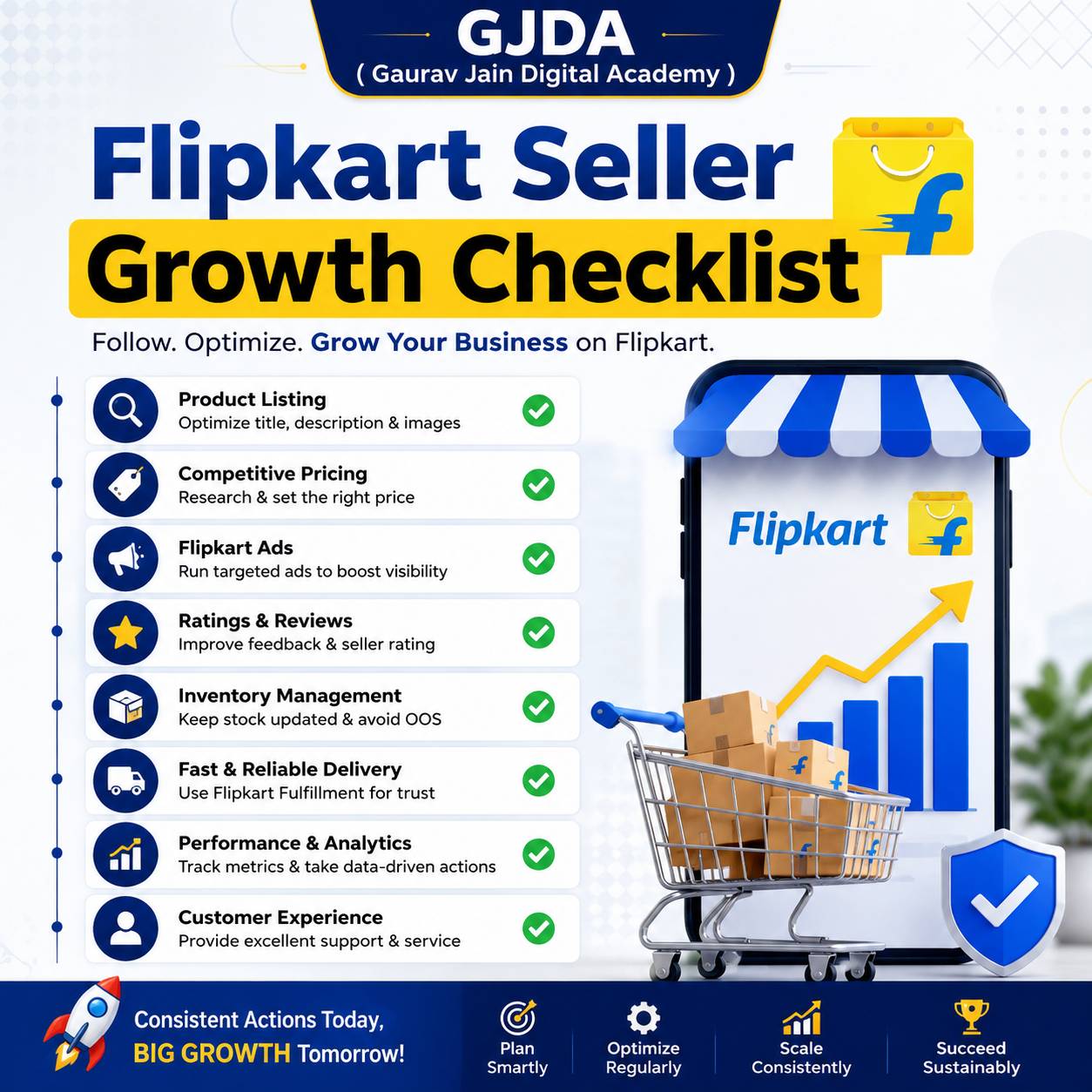
For a step-by-step routine you can tick off, the Flipkart seller growth checklist is a useful companion to this section.
When these strategies may not work
Some categories are simply hard. If your product is a commodity with thin margins, heavy competition, and high return rates, no amount of clever optimisation will rescue it. Sometimes the correct strategic move is to drop the product.
Also, ads work better for products with repeat demand or decent margins. A low-priced item with a ₹30 margin can't carry a ₹40 ad cost. And if your supplier is unreliable, scaling only multiplies the problem.
Useful tools
- Flipkart Seller Hub: your main dashboard for orders, returns, payments, listing quality, and ads. Learn every tab.
- Spreadsheets (Excel or Google Sheets): for profit-per-order calculations, stock tracking, and monthly review. Free, and honestly enough for most small sellers.
- Keyword ideas from Flipkart's own search bar: type your product and note the suggestions. These are real buyer phrases.
- Basic image editing tools: for clean infographics and size charts. Canva-style tools are fine.
- Competitor tracking, done manually: check three or four rival listings weekly for price, images, and review themes. Paid tools exist, but you can learn the habit first without them.
The same skills also transfer to other marketplaces. If you sell on more than one, the Amazon seller growth checklist shows how the same ideas look on a different platform, and the piece on advanced Meesho selling is worth reading if your products are price-sensitive.
Career and business opportunities
Marketplace skills are useful beyond running your own store. E-commerce account managers, catalogue specialists, marketplace ad executives, and operations coordinators all work with the same levers described here. Many small brands hire people who can manage listings, ads, and returns data without needing a large team.
If you want structured practice rather than learning through expensive mistakes, formal Flipkart Seller Training is one route, and you can explore the course topics to see whether they match what you need. Self-learning through Seller Hub and careful record-keeping also works, just slower. At our academy we teach it as a business skill first, not a tool tutorial.
Practical assignment: a two-week profit check
Pick your three best-selling products, or three products you plan to sell. Then:
- Build a sheet with columns for selling price, product cost, commission and fees, shipping, packaging, and average return loss.
- Calculate profit per order for each product, then recalculate with an ad cost you might realistically pay.
- Read the last month of return reasons in Seller Hub and write down the top two for each product.
- Change only one thing on one listing (say, the main image or the size chart) and note the date.
- After two weeks, compare views, orders, and returns for that listing.
You'll probably find one product you should push, one you should leave alone, and one you can't decide about yet. That third one is normal.
Frequently asked questions
How do I rank higher in Flipkart search?
Nobody outside Flipkart knows the exact formula. What you can influence: keyword-rich but readable titles, complete attributes, good conversion, low cancellations, timely dispatch, and healthy ratings.
Do Flipkart ads really increase sales?
They increase visibility, which often increases sales, but not always profit. Compare ad cost per sale with your margin per order before spending more.
Should I join every sale event?
No. Join only where the discounted price still leaves you a margin after fees, shipping, and expected returns.
Is Fulfilled by Flipkart worth it for small sellers?
Depends on your product. It suits steady sellers with standard-size goods. For slow movers or custom items, self-ship can be cheaper. Check the current charges first.
How can I reduce returns?
Read return reasons, then fix the cause: accurate photos, size charts, better packaging, or a supplier change. Return rates rarely drop through one fix.
Does a low price guarantee more orders?
No. Buyers also compare ratings, delivery time, and images. Being the cheapest often just means the thinnest margin.
How many products should I list?
Fewer, better-managed products usually beat a large catalogue you can't monitor. Add more once your first few are stable.
Can I sell on Flipkart and other marketplaces together?
Yes, many sellers do. Just keep inventory synced carefully, since overselling causes cancellations, which hurt you.
How long before I see results from these changes?
Listing fixes may show an effect within a couple of weeks. Rating and ranking improvements typically take longer. Anyone promising a fixed timeline is guessing.
Do I need a course to sell well on Flipkart?
No. A course can save time, but careful tracking, patience, and reading your own data go a long way.
Conclusion
Advanced selling isn't about knowing more tricks. It's about knowing your numbers, fixing the weak lever first, and resisting the urge to chase every sale and every ad. Start with the two-week assignment above, and let the data tell you what to do next.
Most of what looks like "strategy" in this business is just paying attention for longer than the next seller does.