Why Social Media Marketing Skills Are in High Demand
Ask ten shop owners why they are not getting customers online and at least six will say, "I post every day." Posting is not marketing. That gap, between posting and actually bringing in enquiries, is exactly why people who understand social media marketing are hard to find and easy to hire.
The short answer to the title question: businesses of every size now depend on social platforms to be found, trusted and bought from, but most of them lack someone who can do it with a plan instead of a guess. Demand comes from that shortage. Let me explain it the way I would on a classroom whiteboard.
What Social Media Marketing Skill Really Means
Not design. Not luck with reels. Not having 50,000 followers on a personal account.
It is the ability to decide what a business should say, to whom, on which platform, in what format, and then check whether it worked. Content creation is one part. The others are audience research, scheduling, community handling, paid promotion, and reading the numbers afterwards. A person who can do two or three of these well is useful. A person who can connect all of them is the one companies keep.
Why the Demand Exists
Start with where customers spend time. People check Instagram, YouTube, Facebook, WhatsApp and LinkedIn many times a day, and they often look a business up there before they call or visit. If the page looks abandoned or confusing, the business loses the sale quietly. Nobody tells the owner.
Second, the cost of entry is low, which sounds like a good thing and creates a problem. Anyone can open an account, so every competitor in the market has one. Standing out now needs skill, not just presence. Realistically, that is the part businesses cannot do alone.
Third, the platforms keep changing. Formats, reach rules, ad tools and features shift every few months. A business owner busy with stock, staff and payments does not have time to track that. So they look for someone who does.
Fourth, and this is my own observation rather than a statistic: many small businesses still treat social media as a job for "the youngest person in the office." That works for a while. Then the account needs strategy, budgets and reporting, and the youngest person is out of their depth. Trained people fill that gap.
How Social Media Marketing Works in Practice
It follows a loop. You do not run it once and finish.
- Goal first. Followers, enquiries, walk-ins, app installs and sales are different goals, and each needs different content. Most weak campaigns I see have no written goal at all.
- Audience. Who exactly is the customer, and what do they already scroll past? A coaching institute and a bridal boutique do not share a feed, even in the same city.
- Platform choice. Pick one or two, not six. A single platform done properly beats five done half-heartedly.
- Content plan. A mix of useful posts, proof (customer feedback, behind-the-scenes), and direct offers. If every post is an offer, people stop watching.
- Publishing and engagement. Replying to comments and messages is part of the work, not an extra.
- Measurement. Reach, saves, shares, profile visits, link clicks, enquiries. Then change something and test again.
Why does this loop work? Because platforms reward content people respond to, and you only learn what people respond to by measuring. When does it not work? When the product itself is weak, the price is wrong, or nobody answers the phone after the enquiry arrives. Social media can bring attention. It cannot repair a broken business behind it.
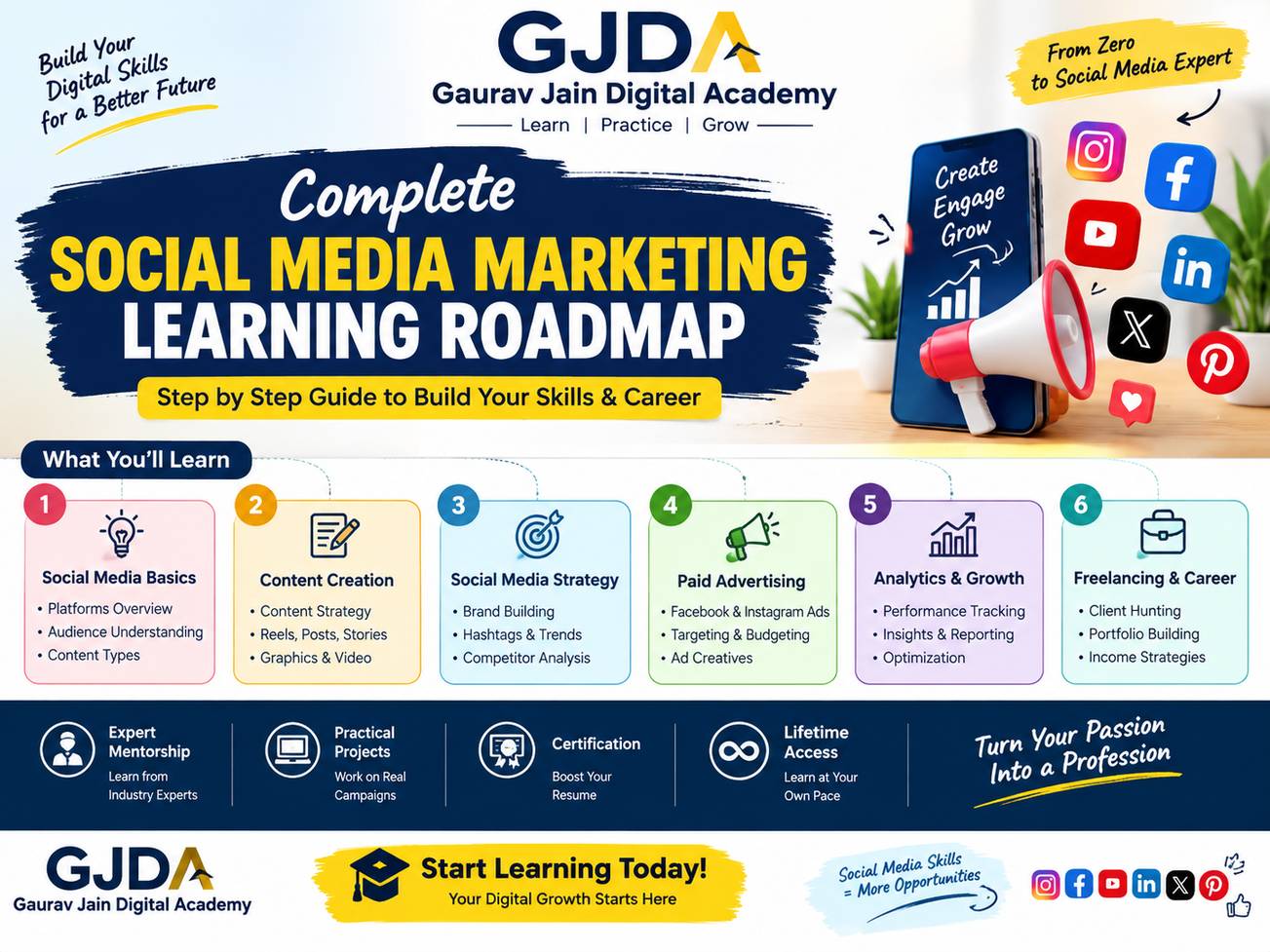
If you are starting from zero and want the order of learning laid out, this step-by-step roadmap for learning social media marketing covers it without jargon.
A Real-World Example (Hypothetical)
I am making this one up on purpose, so treat it as an illustration and not a result.
Imagine a small bakery in a mid-sized city. The owner posts a cake photo every evening, gets a few likes from friends and family, and sees no orders. A trained marketer would change three things. First, a goal: weekend custom-cake enquiries. Second, content: short videos showing the decorating process, a pinned post with price ranges, a story highlight of past orders. Third, a path: every post ends with a simple instruction to message on WhatsApp, and replies go out within an hour.
Would orders rise? Probably, but not overnight, and I would not promise a number. The point is that the improvement comes from planning and follow-through, not from posting more. If you want to see how real campaigns are broken down, this social media marketing case study walks through strategy and outcomes.
Benefits of Having These Skills
For a business owner, the biggest benefit is control. You stop depending on whichever freelancer replies first, and you can judge whether an agency is doing real work or sending you pretty screenshots.
For a job seeker, it is employability. Almost every company with a customer needs someone who understands this, and the skill travels across industries: retail, education, real estate, healthcare, food, fashion.
For students, it is a low-cost way to build a portfolio. You can practise on a friend's shop or a college club page before anyone pays you.
And, quietly, it makes you better at writing, at reading people, and at working with numbers.
Challenges Nobody Mentions Early
It is not easy money. Results are slow, and clients often expect speed. Algorithms change without notice, so something that worked in March may fall flat by August. Organic reach on most platforms is limited, which means serious growth usually involves some ad spend, and ads can waste money fast if you set them up carelessly.
There is also the "everyone is an expert" noise. Plenty of people call themselves social media managers after a weekend, so clients are sometimes burned and become sceptical. Honestly, that is the main reason proof of work matters more than certificates.
One more. Burnout is real when you manage several accounts. It depends on how you organise your calendar, but expect to be always partly on.
Common Mistakes Beginners Make
- Chasing followers. Followers who will never buy do nothing for a local business. Ten hundred of the right people beat ten thousand random ones.
- Copying trends blindly. A trending audio on a dental clinic page may get views and zero patients.
- Posting without a call to action. People will not guess what you want them to do next.
- Ignoring comments and DMs. A slow reply is often a lost customer.
- Judging by likes. Likes feel good. Saves, shares, enquiries and sales tell you more.
- Boosting posts without targeting. The "Boost" button is easy and often wasteful.
Best Practices That Hold Up
Keep a simple content calendar, even if it is a spreadsheet. Plan a mix: roughly some posts that teach, some that prove, and a few that sell. I do not have a magic ratio, and anyone who gives you one as law is guessing. Test it on your own audience.
Write in the language your customer actually speaks. For many Indian businesses that means Hindi or Hinglish captions, not stiff textbook English.
Look at your numbers weekly, not daily. Daily checking leads to panic over normal fluctuations.
Study why some posts spread and others do not. A good starting point is learning how viral campaign ideas are built, though keep in mind that virality is never guaranteed and should not be your only plan.
Useful Tools
| Purpose | Examples | When it helps |
|---|---|---|
| Design | Canva, CapCut | Posters, reels, quick edits without a designer |
| Scheduling | Meta Business Suite, Buffer, Hootsuite | Planning posts ahead so you are not rushing daily |
| Analytics | Instagram Insights, Facebook Insights, YouTube Studio | Seeing what content actually performs |
| Ads | Meta Ads Manager | Reaching specific audiences with a budget |
| Messaging | WhatsApp Business | Catalogues, quick replies, handling enquiries |
| Research | Google Trends, platform search bars | Spotting what people are asking about |
Tools do not make a strategy. A free app used with a clear plan will beat a paid suite used without one.
Career Opportunities
Roles differ by company size. In a small business, one person often handles everything. In agencies and larger firms, work splits into specialist jobs.
| Role | What the person mostly does |
|---|---|
| Social Media Executive | Posting, scheduling, replying, basic reporting |
| Content Creator / Video Editor | Reels, shorts, graphics, captions |
| Community Manager | Handling audience conversations, groups, reviews |
| Paid Social Specialist | Running and optimising ad campaigns |
| Social Media Strategist | Planning goals, channels and content direction |
| Freelancer or Consultant | Handling several small clients independently |
Pay varies a lot by city, skill and experience, so I will not quote figures. Check current job listings in your own area for a realistic picture. The field is also shifting as AI tools take over routine tasks; this piece on how AI is shaping marketing careers is worth reading alongside this one.
A Practical Assignment You Can Do This Week
- Pick a real local business, such as a salon, a tuition centre or a sweet shop. Ask permission if you plan to share your work with them.
- Write down one goal for them, for example more WhatsApp enquiries.
- Look at their current page. Note what is missing: contact details, clear offers, recent posts, replies to comments.
- Draft a seven-day content plan with a mix of teaching, proof and offer posts.
- Create at least two of those posts and write the caption in the customer's language.
- List three numbers you would track after posting, and say why.
Do not worry if the first attempt feels amateur. It will. The learning is in comparing your plan with what happens afterwards.
Frequently Asked Questions
1. Is social media marketing a good career in India right now?
For people who build real skills, yes. For people hoping to get hired on a certificate alone, it gets harder each year because the competition is large.
2. Do I need a degree to get a job?
Not usually. Employers and clients tend to care more about your work samples, your understanding of platforms and how you explain your decisions.
3. Can I learn it on my own with free videos?
You can, and many do. The usual trouble is order and feedback: without someone checking your work, mistakes stay invisible. It depends on how disciplined you are.
4. How long does it take to become job-ready?
There is no single answer. With regular practice, a few months is a reasonable range for entry-level work, but real confidence comes from handling actual accounts.
5. Is it only about Instagram?
No. Facebook, YouTube, LinkedIn, WhatsApp and others matter depending on the business. A B2B company may care more about LinkedIn than Instagram.
6. Will AI replace social media marketers?
AI will take over drafting, resizing and some reporting. Judgement about audience, brand voice and strategy is harder to hand over, so people who combine tools with thinking should stay useful.
7. Do small businesses really need a paid marketer?
Not always. A motivated owner can handle basics. Once ads, multiple platforms or regular reporting enter the picture, expert help usually pays for itself, though it is not guaranteed.
8. What is the difference between social media marketing and social media management?
Management is mostly daily upkeep: posting, replying, scheduling. Marketing adds goals, audience targeting, paid promotion and measuring business results.
9. Can I freelance while studying?
Yes, many students start with one or two small local clients. Keep the workload realistic so your studies do not suffer.
10. Where should a complete beginner start?
Pick one platform, one business and one goal. If you want a structured path from the basics, this trainer's roadmap for beginners lays out the sequence.
Where This Leaves You
Demand for these skills exists because businesses need attention, trust and customers, and the platforms where that happens are crowded and always changing. Skilled people are fewer than the work available. That is the whole story, minus the hype.
If you decide to learn formally, a structured option such as the beginner's course at GJDA can give you feedback on your work, and you can check the detailed curriculum before deciding. Whether you go that way or learn on your own, start with the assignment above this week. A small real attempt teaches more than another month of reading.