Ask ten marketers what AI will do to their jobs and you'll get ten confident answers, most of them wrong in at least one detail. Nobody knows the exact shape of 2030. What we can do is look at what's already shifting, work out why it's shifting, and decide what is worth learning now versus what is just noise.
That's the plan here. This guide covers the trends in AI marketing that look durable, how each one works, where it breaks, and what a beginner, a student, a small business owner or a working professional should actually do about it. No predictions dressed up as facts.
What people really want to know when they search this topic
The search is informational. Someone typing "future trends in AI marketing" usually wants three things: a clear list of what's changing, an honest sense of whether it affects them, and a hint about where to start. So that's the order we'll follow.
What "AI marketing" means before we talk about its future
Most beginners picture a chatbot that writes captions. That's one small corner. AI marketing is any use of machine learning or generative AI to plan, create, deliver, measure or improve marketing work. Writing an ad is one use. Predicting which customers will stop buying is another. Deciding which email subject line goes to which person is a third. Different tools, different skills.
Why does this distinction matter for trends? Because the future isn't one big wave. It's several separate currents moving at different speeds, and some of them will matter far more to a local shop than to a global brand.
Why these trends matter to you specifically
Marketing used to reward whoever could produce more, faster. Generative AI has made "more, faster" cheap for everybody. So the advantage is moving elsewhere: toward judgment, original information, good data and trust. That shift is the real story underneath every trend below.
If you run a small business, it means a competitor with no budget can now publish daily. If you're a student, it means entry-level tasks are changing shape. If you're a professional, it means your value sits less in doing the task and more in knowing whether the output is any good.
Trend 1: Search is turning into answers
People increasingly get a summarized answer at the top of the results page, or inside an AI assistant, instead of clicking ten blue links. Google's AI Overviews and chat assistants both work this way. The practical effect is that fewer people may visit a site for simple questions, while the sites that get cited or recommended gain visibility.
How do you adapt? Write pages that answer one question clearly, early, and then add depth. Keep facts accurate, name your sources of experience, and make your business details consistent across your website, Google Business Profile and directories. This is sometimes called answer engine optimization, and honestly it's mostly good old SEO with sharper writing.
When does it not apply? If your customers find you through referrals or marketplaces, you'll feel this trend less. It also changes quickly, and nobody outside the search companies fully knows how citations are chosen. Treat anyone selling a guaranteed formula with suspicion.
Trend 2: AI agents that do multi-step work
A chatbot answers. An agent acts: it reads your brief, pulls data, drafts the email, schedules it and reports back. Early versions already exist inside automation and marketing platforms, though they're patchy. They misread instructions, get stuck, and sometimes do confidently wrong things.
The sensible way to think about agents is as fast, slightly careless juniors. You'd never let a new hire email your whole customer list unsupervised, so don't let an agent do it either. If you want to see what a basic version of this looks like in practice, this walkthrough on building an AI-powered marketing workflow shows how the pieces connect before any agent is involved.
Trend 3: Personalization that goes past "Hi, [First Name]"
Real personalization means the message, offer, timing or even the page layout changes based on what a person did, not just who they are. A shopper who looked at running shoes twice sees a different email from one who bought a jacket. AI makes this practical for small teams because it can sort behavior into groups and draft variations without a data science department.
The catch: it needs clean data, and many small businesses don't have any. A customer list in three different spreadsheets, half with missing emails, won't be rescued by software. Also, there's a line between helpful and creepy. If a message makes someone wonder how you knew that, you've probably overshot.
Trend 4: Predictive analytics moving into everyday tools
Forecasting which leads will convert, which customers may leave, or which ad is fading used to need specialists. Now it's showing up as a button inside analytics and ad platforms. Better decisions come from this, but only if the person reading the prediction understands what it's built on. A score isn't a fact. It's a guess with some math behind it. For a grounded explanation of how these tools feed decisions, read about using AI for marketing analytics.
Trend 5: Creative production at scale, and the backlash that follows
Image, video, voice and copy generation keep improving. Expect more brands to test dozens of ad variations instead of two. Expect also a quiet fatigue among audiences who can spot generic AI writing from the first sentence. Both will be true at once.
I'll be honest: the brands that win here won't be the ones producing the most. They'll be the ones with a real point of view, real product knowledge and a human who edits hard. Rules on disclosure of AI-generated content are also developing in different countries, so check the platform and local requirements before you publish anything that mimics a real person or testimonial.
Trend 6: Privacy, first-party data and less tracking
Browsers and platforms keep limiting third-party tracking, and users are more aware of consent. That pushes marketers toward data they collect themselves: email sign-ups, purchase history, WhatsApp opt-ins, form responses. AI models then work on that owned data. Smaller than before, but cleaner and legally safer.
How these trends fit together
| Trend | What changes | Who feels it first | Skill to build |
|---|---|---|---|
| Answer-based search | Visibility depends on being cited or recommended | Publishers, local services, educators | Clear writing, accurate facts, consistent business details |
| AI agents | Multi-step tasks run semi-automatically | Teams with repeat workflows | Process thinking and review habits |
| Personalization | Messages adapt to behavior | E-commerce, courses, subscriptions | Data hygiene, segmentation |
| Predictive analytics | Forecasts inside everyday tools | Anyone running paid ads or email | Reading metrics skeptically |
| AI creative | Cheap variation, more sameness | Social and ad teams | Editing, brand voice, testing |
| Privacy shift | Owned data becomes the asset | Almost everyone | Consent-based list building |
A hypothetical example: a neighborhood coaching centre
This is an imagined scenario, not a real client. Say a small coaching centre has 400 past inquiries in a spreadsheet. First, they clean the list and tag each person by interest: spoken English, computer basics, exam prep. Next, they use an AI assistant to draft three short WhatsApp and email messages per group, then edit them so they sound like the owner. A simple automation sends a follow-up if someone clicks but doesn't reply. Finally, they ask the AI to summarize which message got the most replies.
Nothing exotic there. But it touches personalization, workflow automation and light analytics in one afternoon of setup. It might fail, too. If the list is old, many numbers are dead, and no tool fixes that.
Benefits worth taking seriously
- Speed on routine work: first drafts, reports, subject-line variations, research summaries.
- Smaller teams can attempt things that once needed an agency, such as testing ten ad angles or segmenting a list properly.
- Decisions get a second opinion from the data, which is handy when your gut and the numbers disagree.
- Learning is faster, because you can ask an assistant to explain a metric or critique a plan at any hour.
Challenges and trade-offs
Accuracy comes first. Generative tools can state wrong things smoothly, including invented statistics and fake sources. Anything with numbers, legal claims or health claims needs human checking, every time.
Then there's sameness. When everyone uses the same tools with the same prompts, outputs converge. Dependence is another one: if you can't judge good copy without the tool, you can't tell when it fails. And privacy rules still apply to your customer data, so pasting a customer list into a public AI tool without thinking is a real risk. It depends on the tool's settings and your local laws, so read before you paste.
Common mistakes beginners make
Publishing raw output is the big one. Close behind: buying five tools before defining one problem. Many people also confuse activity with results, as in "we posted 30 times this month" with no idea whether any of it brought a customer.
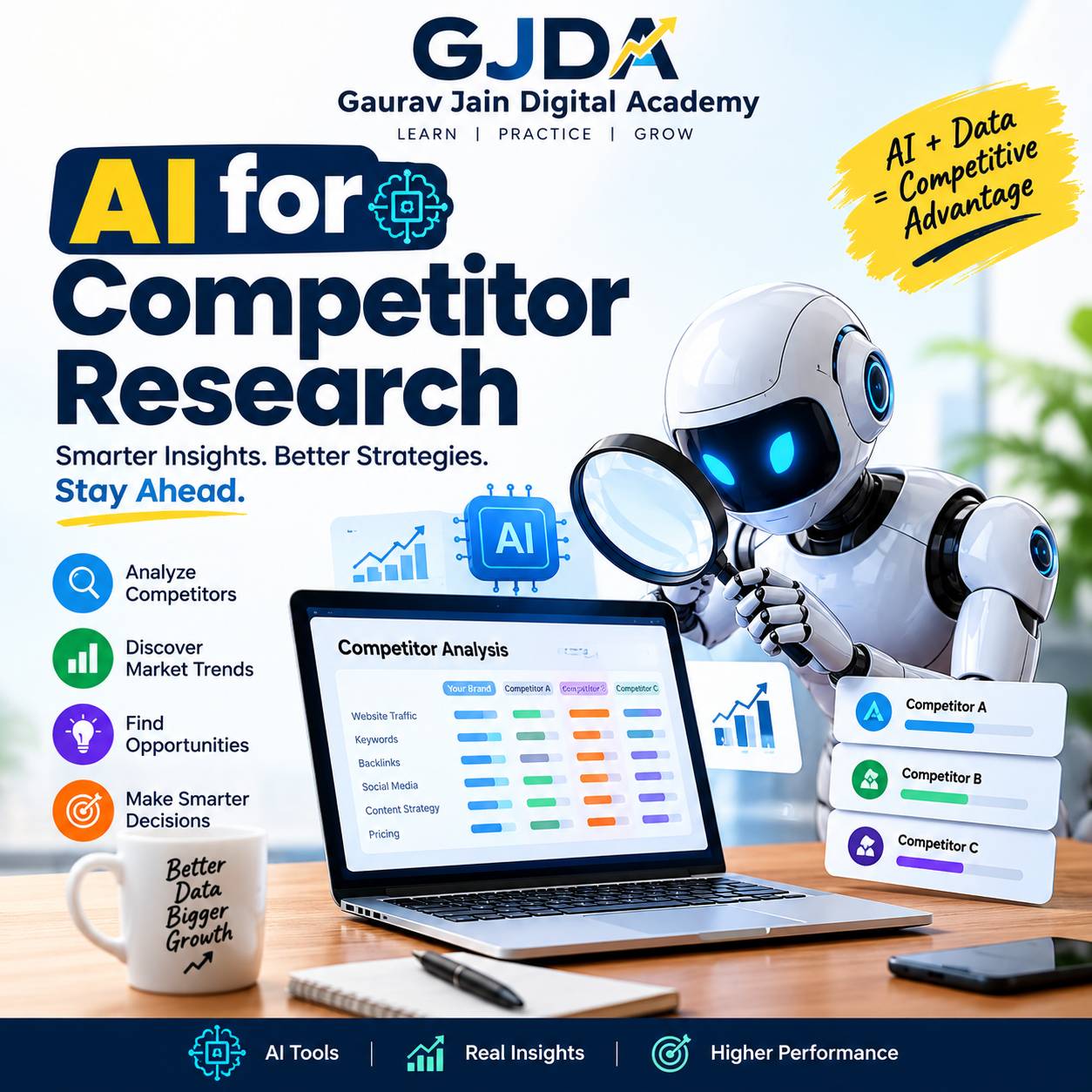
A subtler mistake is copying a competitor's AI-driven tactic without knowing if it suits your audience. Doing some homework first helps, and AI-assisted competitor research can show you what rivals are doing without you simply imitating them. And one more, small but common: skipping measurement because setting it up feels boring.
Best practices that should survive every tool change
- Start with a goal, a customer and a number you can measure. Tools come after.
- Keep a human review step for anything that goes public or touches customer money or health.
- Collect your own data with permission, and keep it tidy.
- Test small before scaling. One audience, one channel, two weeks.
- Write down your prompts and what worked. Over time that becomes your own playbook.
- Add something the tool can't: your real experience, local knowledge, photographs, price lists, honest comparisons.
Prompting is a skill in itself, and students in particular benefit from practicing it as a thinking exercise rather than a shortcut. This piece on AI prompts that help students think like marketers is a good place to start.
Useful tools to know about
Tools change often, so treat this as a map, not a shopping list. Check current pricing and features on each official site.
| Job | Examples | Good for |
|---|---|---|
| Writing and brainstorming | ChatGPT, Claude, Gemini | Drafts, outlines, critique, research summaries |
| Design and video | Canva, Adobe Firefly, CapCut | Social creatives, quick edits, resizing |
| Analytics | Google Analytics, Looker Studio | Tracking traffic and conversions |
| Email and CRM | HubSpot, Mailchimp, Zoho | Segmentation, automated follow-ups |
| Automation | Zapier, Make | Connecting forms, sheets, email and messaging |
| Ad platforms | Google Ads, Meta Ads | Built-in automated bidding and creative testing |
You don't need all of these. Realistically, one writing assistant, one analytics tool and one email or CRM tool cover most small-business needs.
Career opportunities
Does AI shrink marketing jobs? Some tasks, yes. Basic copy production and simple reporting are the obvious ones. But roles are also appearing around marketing automation, AI-assisted content strategy, analytics, and campaign operations. Nobody can say precisely how the job market will settle, so the safest approach is building a mix: one hard skill (analytics, SEO, paid ads, automation) plus strong communication and judgment. For a broader view of where roles are heading, see this overview of the future of AI marketing careers.
If you prefer structured learning over piecing it together from videos, a beginner's course in AI marketing can save time, and the detailed curriculum page lists exactly which topics are covered so you can judge it against your own goals. At GJDA we teach this in a classroom setting, but plenty of people learn well on their own too. Either route works if you actually practice.
Practical assignment: build your own trend radar
Try this over one week. It costs nothing but time.
- Pick one real or imagined business, such as a tailoring shop, a clinic, a bakery or your own side project.
- Write down its single most important goal for the next 90 days: more inquiries, more repeat buyers, more footfall.
- From the six trends above, choose the two that touch that goal most. Ignore the rest for now.
- For each, run one small experiment. For example, rewrite your three most important web pages to answer a customer question clearly, or segment your contact list into two groups and send each a different message.
- Record what you did, what the tool suggested, what you changed, and the result.
- At the end of the week, write three sentences: what worked, what didn't, what you'd change.
The goal isn't a perfect result. It's learning to separate a trend that matters for your situation from one that merely sounds exciting.
Frequently asked questions
Will AI replace marketers?
Some tasks will be automated, and some roles will change. Marketing still involves understanding people, taking responsibility for claims, and making judgment calls under uncertainty, which tools handle poorly. Nobody can promise an outcome, but people who combine domain skill with AI fluency are in a stronger position than those who ignore it.
What is the biggest trend in AI marketing right now?
There isn't one winner. For most people, the combination of AI-generated content and answer-style search affects daily work the most. For ad-heavy businesses, automated bidding and creative testing matter more.
Do small businesses really need AI marketing?
Need is a strong word. You can run a good business without it. But repetitive jobs like follow-ups, reporting and first drafts are where small teams gain the most, so a light, selective approach usually makes sense.
Is AI-generated content bad for SEO?
Google has said it focuses on helpfulness and quality rather than how content is produced, though it does act against spam-like mass-produced pages. In practice, unedited generic content tends to perform poorly because it adds nothing new. Check Google's current guidance, since it gets updated.
What should a beginner learn first?
Marketing basics: audience, offer, channel, measurement. Then one tool at a time. Skipping fundamentals and jumping straight to prompts is the most common regret I hear about.
Do I need coding skills?
No, not for most marketing roles. Comfort with spreadsheets and basic analytics matters more. Coding becomes useful if you move toward advanced automation or data work.
How do I know if an AI tool is worth paying for?
Try the free version on a real task first. If it saves you measurable time or improves a number you track, consider upgrading. If you can't say what it improved, it probably isn't worth it yet.
Can AI write all my social media posts?
It can draft them. Posting them untouched usually sounds generic, and it may get facts wrong. Treat it like a rough first pass you then rewrite in your own voice.
Is it safe to upload customer data to AI tools?
It depends on the tool's data policy, your settings, and the privacy laws that apply to you. When unsure, remove names and contact details first, or use tools whose business plans clearly state how data is handled.
How long does it take to get good at AI marketing?
Basic competence can come in a few weeks of regular practice. Real judgment, meaning knowing what to trust and what to change, takes months of doing actual campaigns.
Which trend should I ignore?
Whichever one doesn't connect to your goal this quarter. Every trend is worth understanding; very few are worth acting on all at once.
Conclusion
The tools will keep changing, probably faster than any article can track. What's holding steady is the work underneath: know your customer, collect honest data, test small, check what the machine gives you, and add something only you can offer. Pick one trend, run one experiment this week, and you'll learn more than from reading ten more forecasts.